 By
By
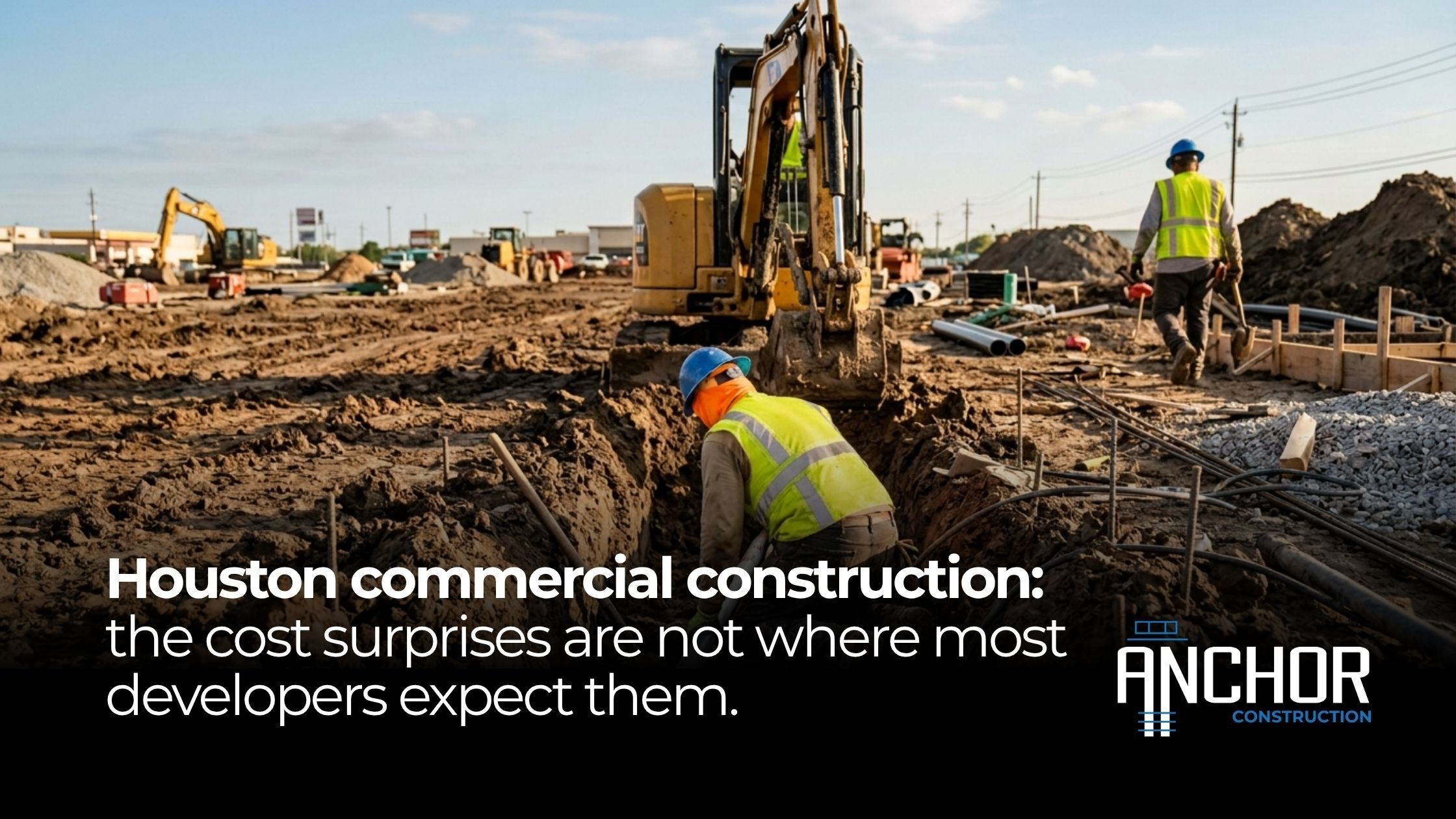
Houston is growing faster than it has in years and the construction market is running to keep up. If you are planning a commercial project in this city right now, you already know the basic story: costs are up, timelines are tight, and the estimates from two years ago do not apply anymore.
What most developers do not know is where the cost movement is actually coming from. The headline numbers, commercial construction in Houston ranging from $240 to $380 per square foot in 2026 depending on project type, tell you the range. They do not tell you what is moving fastest inside that range and why.
I asked David Coyle Jr., our Estimator III at Anchor Construction, the question that matters most to anyone building in Houston right now. David prices commercial projects across the Houston metro every day. His answer is not what most developers expect to hear.
Commercial construction costs in Houston are running $240 to $380 per square foot in 2026 for most project types, with annual escalation at 3 to 6 percent. The biggest cost movement is coming from sitework, utilities, and skilled labor availability, not materials. Schedule-driven logistics are a close second, as utility delays compound costs on projects with drainage challenges, difficult soil, or long-lead equipment. Developers who budget based on materials and labor alone are missing the line items that are actually breaking budgets right now.
TL;DR
-
Houston commercial construction: $240-$380/SF in 2026 depending on project type, with annual escalation running 3-6%
-
Biggest cost movement: sitework, utilities, and skilled labor, not materials (the answer most developers do not expect)
-
Schedule-driven logistics are a close second: utility delays compound costs on drainage-challenged sites and long-lead equipment
-
Site complexity (poor soil, utility extensions, drainage) can add 10-15% or more to any baseline per-square-foot estimate
-
Houston carries the highest commercial construction costs in Texas, windstorm codes, floodplain compliance, and trade labor demand all contribute
Where Is Commercial Construction Cost Moving Most in Houston Right Now?
That is the question every developer and owner asks when they sit down with an estimator. The answer changes faster than most budget assumptions.
Q: With Houston's growth right now, where are you actually seeing cost per square foot move the most - and is it material cost, labor, or something else people do not expect?
"Biggest movement by far has been from sitework, utilities, and skilled labor availability. Schedule-driven logistics run a close second, as the long utility delays really push cost as well, especially on projects with challenging drainage, difficult dirt, or long-lead equipment."
- David Coyle Jr., Estimator III, Anchor Construction
That answer lands differently when it comes from someone who is actively pricing Houston commercial projects. The reflex for most developers is to track material costs, lumber, steel, concrete, because those are the line items that made headlines during the supply chain disruptions of 2021 and 2022. Materials have largely stabilized. The cost pressure has migrated.
Sitework, utilities, and skilled labor are moving for reasons that are directly tied to Houston's growth. More projects competing for the same sub network, more utility infrastructure being installed across the metro simultaneously, and more drainage complexity per project as development pushes into sites that require more civil engineering work than a standard pad did five years ago.
This is also why the per-square-foot number alone is not sufficient for budgeting. For a broader look at how these costs break down across project types and Texas markets, see our guide on commercial construction cost per square foot in Texas.
What Do Houston Commercial Construction Costs Actually Look Like by Project Type?
The range of $240 to $380 per square foot covers a lot of ground. What that number means for your project depends entirely on what you are building.
|
Project Type |
Cost Range / SF (Houston 2026) |
Key Cost Drivers |
|
Retail build-out (TI) |
$140-$180 / SF |
MEP density, brand spec compliance, finish quality |
|
Ground-up retail / strip |
$240-$320 / SF |
Site prep, drainage, utilities, tilt-wall vs. steel frame |
|
Restaurant (QSR) |
$280-$380 / SF |
Hood systems, grease interceptors, drive-through civil work |
|
Hospitality / hotel |
$340-$500 / SF |
MEP complexity, guest room finishes, code compliance |
|
Industrial / warehouse |
$190-$280 / SF |
Slab thickness, clear height, dock equipment, power load |
|
Mixed-use commercial |
$300-$420 / SF |
Phased coordination, shared utilities, parking structure |
These ranges assume a reasonably straightforward site. Houston's soil conditions, drainage requirements, and floodplain regulations mean that site complexity is one of the most variable factors in the final number.
According to industry cost data, site and infrastructure challenges poor soil, utility extensions, drainage complexity, easements can add 10 to 15 percent or more to a per-square-foot budget. In Houston specifically, that variability is higher than in most other Texas markets because of the city's drainage requirements and the diversity of soil conditions across the metro.
Why Are Sitework and Utilities Moving Faster Than Materials in Houston?
David's answer points to three converging forces. Understanding each one is what separates a budget that holds from one that does not.
1. Houston's drainage and soil complexity. The city's flat topography, expansive clay soils, and strict Harris County Flood Control requirements mean that drainage engineering is more complex and more expensive here than in most Texas markets. As development pushes into sites that were previously considered secondary further out from established infrastructure the civil engineering cost per project increases. A developer who uses a downtown Houston baseline to estimate a suburban Katy or Pearland site is starting with the wrong number.
2. Utility infrastructure under strain. Houston's growth is adding residential, commercial, and industrial development simultaneously. Water, sewer, and electrical utility infrastructure is being extended across the metro faster than it has been in years. Lead times for utility connections and for the equipment required to make them are longer than the pre-growth baseline. A project that has to wait three months for a utility connection that was expected to take six weeks has a cost problem that shows up in general conditions and overhead, not in the materials line.
3. Skilled labor in a market running at capacity. Electricians, plumbers, concrete finishers, and HVAC technicians are in high demand across every major Texas market simultaneously. In Houston specifically, skilled trades are seeing 4 to 6 percent annual wage growth. The best subcontractors are committed months in advance. A GC without established sub relationships in the Houston market is not competing on the same playing field as one who has.
The schedule-driven logistics David mentions are the downstream effect of all three. When a utility connection is delayed, the general conditions clock keeps running. When a long-lead piece of equipment is late, every trade that follows it in the sequence gets pushed. The cost of a six-week schedule slip on a commercial project in Houston is not just six weeks of general conditions it is the ripple through every subcontract that was sequenced around an opening date.
This is why the pre-construction process matters more in Houston than in less complex markets. For more on how strong pre-construction discipline prevents these costs, see our breakdown of how construction management reduces change orders on retail projects.
How Does Houston Compare to Other Texas Markets on Cost?
Houston consistently carries the highest commercial construction costs in Texas. Understanding why helps developers evaluate whether the Houston premium is specific to their project type or a general market condition.
- Houston vs. DFW: Houston runs several percent above DFW for comparable commercial projects. The Houston premium comes from windstorm and hurricane-resistant structural code requirements, floodplain compliance complexity, and stronger sustained trade labor demand. DFW's faster permitting in suburban municipalities partially offsets its cost advantages.
- Houston vs. Austin: Austin is climbing fast due to LEED and sustainability requirements and tech-sector construction demand, but still trails Houston on total project cost for most commercial types. Austin's longer permit review cycles typically 8 to 12 weeks for commercial retail create schedule risk that translates into cost, making the gap narrower in practice than the per-square-foot comparison suggests.
- Houston vs. San Antonio and Corpus Christi: both offer better cost efficiency for comparable project types. San Antonio benefits from lower labor competition and more predictable permitting. Corpus Christi adds coastal construction requirements for foundation and wind resistance, but the overall market is less constrained than Houston.
For developers running programs across multiple Texas markets, these differences mean that a single budget assumption does not travel. A Houston estimate applied to a San Antonio site will be conservative. The same estimate applied to a challenging Houston site with drainage complexity may be optimistic.
For a deeper look at how these markets differ in terms of retail activity, permitting, and subcontractor availability, see our analysis of why retail chains struggle coordinating construction across Texas regions.
What Does This Mean If You Are Planning a Commercial Project in Houston?
The market David is describing is not going to get simpler in the near term. Houston is adding population, adding commercial development, and adding pressure to utility and labor infrastructure simultaneously. The developers who come out of this cycle with projects that stayed on budget are the ones who engaged an estimator with active Houston market knowledge before the design was finalized, not after.
Here is what that looks like in practice:
- Get a site-specific civil assessment before you budget. The per-square-foot ranges in this post are market averages. Your site's soil conditions, drainage requirements, and utility access determine whether you land at the low end or the high end of those ranges. That assessment needs to happen before any number goes into a proforma.
- Build utility lead times into your schedule from day one. Do not assume a utility connection will happen on the standard timeline. In the current Houston market, utility delays are creating schedule pressure that shows up as cost long before any materials arrive on site.
- Choose a GC with established sub relationships in Houston. The difference between a GC who has to find subs at bid day and one who has pre-qualified relationships with the trades your project needs is real and measurable in both cost and schedule.
- Add a meaningful contingency. Standard industry guidance is 5 to 10 percent. In Houston in 2026, given the sitework variability David describes, 8 to 10 percent is the more defensible number for a commercial ground-up project.
We understand what is at stake time, capital, and execution. If you are planning a commercial project in Houston, the context in this post is what our estimating team works with every day.
To see what Anchor has built across Houston and the projects our team has priced and delivered, explore our commercial portfolio across Houston and Texas.
Planning a commercial project in Houston? Talk to our estimating team before you finalize the budget.
View our Houston projects | Talk to our team