 By
By
To choose acommercial general contractor in Texas, compare candidates on five things before price: completed projects that match your building type and size, the named superintendent and project manager, a written preconstruction process, subcontractor relationships in your metro, and how the contractor prices risk and change orders. Then check references with owners, not only architects. The lowest bid only wins when the scope behind it is complete.
TL;DR
• Judge a GC on execution evidence, not on the bid total: comparable projects, the assigned team and a documented preconstruction process.
• Bring the GC in before design is final. That is when civil, permitting and budget problems are cheapest to fix.
• Texas is not one market. Houston, Dallas-Fort Worth, Austin, San Antonio and Corpus Christi each have different permitting, site and labor conditions.
• The five most expensive mistakes: choosing on price alone, engaging the GC late, ignoring communication, assuming experience transfers across project types, and rushing the start.
Why Does Your Choice of General Contractor Matter So Much?
Choosing a general contractor is one of the most consequential decisions in a commercial development. The contractor shapes the budget during preconstruction, controls the schedule in the field and determines whether the finished asset is ready to lease or operate on day one.
In Texas, that decision carries extra weight. Population growth keeps commercial demand high, the best subcontractors are booked months ahead, and costs are moving. Construction input prices rose 6.2% in the first four months of 2026, more than during the prior three years (4.8%), according to Associated Builders and Contractors. In that environment, a contractor who wins on the lowest number and figures out procurement later puts the whole pro forma at risk.
Speed still matters. But the fastest projects are rarely the ones pushed hardest at the start. They are the ones coordinated properly from the beginning.
How Do You Choose a Commercial General Contractor in Texas?
1. Define the project before you build a shortlist. Give every contractor the same brief: building type, size, site, design status, target opening date and budget range. Contractors can only be compared when they price the same thing.
2. Ask for completed projects that match yours. Relevant experience matters more than total experience. Retail pads demand speed and brand precision, multifamily demands phased coordination at scale, and hospitality demands brand compliance and finish sequencing. Ask for projects of your type, size and market, and call the owners.
3. Meet the people who will run your job. Ask who the superintendent and project manager will be, what else they are committed to, and whether they stay from preconstruction through closeout. A contractor who cannot name the field leader at proposal stage is likely to assign one at the last minute.
4. Test the preconstruction process. Ask for it in writing. A strong process includes site and civil analysis, a permitting plan for the specific jurisdiction, design coordination review and a budget built on input from local subcontractors.
5. Check subcontractor depth in your metro. A contractor with strong trade partners in Houston may not have the same bench in Austin or San Antonio. Ask who the key framing, MEP and finish subcontractors will be in your market.
6. Compare proposals on the same scope. Line up exclusions, allowances, contingencies, fees and schedule assumptions before comparing totals. A lower bid with broad exclusions is not a lower cost.
7. Ask how the contractor manages cost risk. Ask how change orders are priced, whether the contract includes an escalation clause on volatile materials, and how cost updates are reported. The answers show whether the contractor’s incentives line up with catching problems early.
What Are the Most Common Mistakes When Choosing a General Contractor?
1. Choosing on the lowest bid alone. Low bids often carry scope gaps, unrealistic schedules or thin coordination. What looks like savings at signing tends to return as change orders. Evaluate value, not just price.
2. Bringing the contractor in too late. When design, engineering and construction are not aligned early, the result is rework, delays and budget increases. Engage the contractor during preconstruction.
3. Treating communication as a soft skill. A commercial project involves developers, architects, engineers, subcontractors and operators. Slow responses and missing updates turn small issues into big ones. Ask how and how often the contractor reports progress.
4. Assuming experience transfers across project types. A contractor who performs well in one sector may not deliver the same results in another. Match the portfolio to your building type and market.
5. Rushing the start to save time. Projects pushed too hard at the beginning often become the ones with the biggest delays later, because missed planning details compound in the field.
Why Does Local Market Knowledge Matter in Texas?
Every Texas metro builds differently. In Houston, drainage requirements, clay soils and floodplain rules make sitework one of the most variable costs. In Dallas-Fort Worth, permitting speed differs from one suburban municipality to the next. Austin’s commercial review often runs 8 to 12 weeks. San Antonio tends to offer more predictable permitting and lower labor competition, while Corpus Christi adds coastal wind and foundation requirements.
A contractor who knows these differences builds them into the budget and schedule from day one. One who does not discovers them after mobilization, when they cost the most.
What Does Strong Execution Look Like on a Real Project?
Two recent Anchor projects show what disciplined execution produces.
Multifamily, delivered through a pandemic. Aria at Burke, a 152-unit community in Pasadena, Texas, was a $14 million project on 4.8 acres completed in 14 months, with most of construction during the pandemic. The team held the schedule through supply chain disruptions, material shortages and labor constraints through early alignment across teams, real-time problem solving and disciplined schedule management. Speed came from preparation, not pressure.
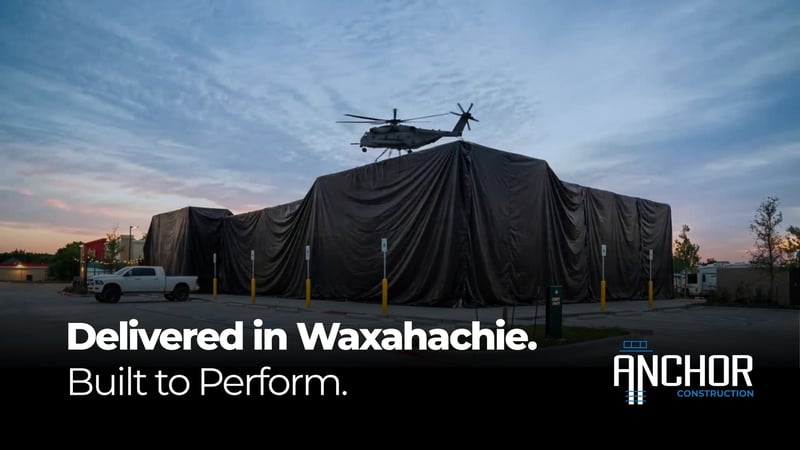
Retail, delivered ready to lease. In Waxahachie, on a primary corridor into Dallas-Fort Worth, Anchor delivered an 8,439-square-foot multi-tenant retail building on 1.512 acres along US Highway 77, with four leasable suites, three storefronts and a drive-thru end-cap. The scope included full sitework, stormwater detention and the exterior package, delivered as a shell built to accommodate future tenants efficiently.
What Is the Difference Between a Builder and a Construction Partner?
A builder completes the construction tasks in the contract. A construction partner helps the developer manage risk before construction starts: it shapes the budget in preconstruction, flags cost and schedule risks early, and measures success by how the finished asset performs, not only by when the project closes out. At Anchor Construction, a family-owned commercial general contractor based in Missouri City, Texas, that principle guides every project: Prudent. Professional. Quality.
Before you sign, use our guide on what to ask your GC before signing a commercial construction contract. [Link to /newsroom-anchor/what-to-ask-gc-before-signing-commercial-construction-contract]
Planning a commercial project in Texas? Talk to our team | View our projects