 By
By
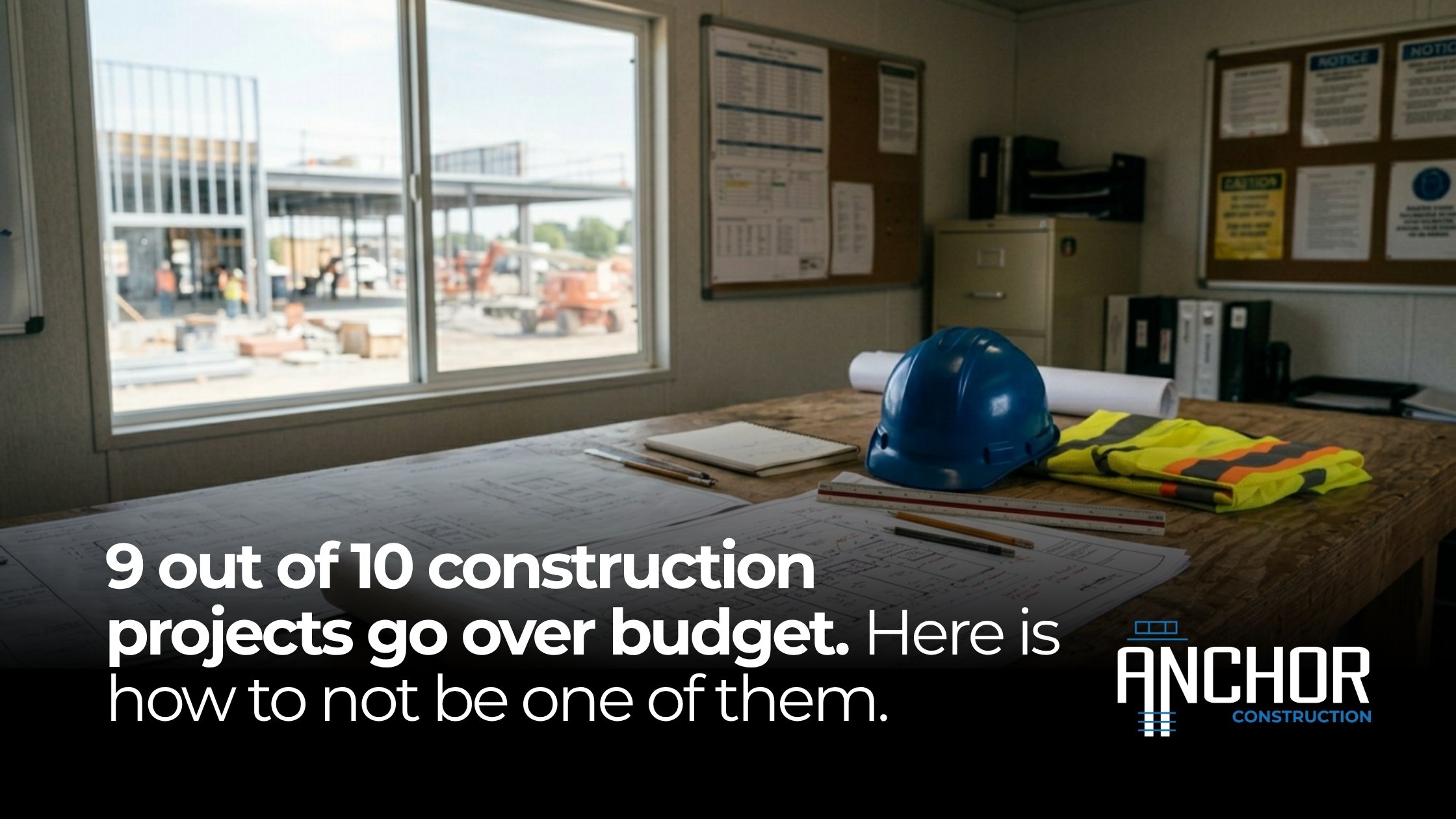
Change orders are not bad luck. They are what happens when the planning phase does not do its job.
If you have developed retail projects in Texas, you have felt this: a scope change here, an unforeseen condition there, a brand specification that was not in the original drawings. By the time the project wraps, the final number looks nothing like the number you started with. Industry data puts the average construction cost overrun at 15 to 28% of original budget, and nine out of ten projects experience it.
The way to break that pattern is not more contingency. It is a construction management approach that catches problems before they become line items. In this post, I will break down exactly how that works in retail projects specifically, where brand specs, MEP complexity, and compressed timelines create a very particular kind of change order risk. At Anchor Construction, this is how we build.
Construction management services reduce change orders in retail projects by catching scope gaps, design conflicts, and brand specification errors during pre-construction, before work begins. The three highest-impact phases are constructability review, early MEP coordination, and permit pre-check. Projects with proper planning stay an average of 6.5% under budget; poorly planned projects exceed costs by 3.3% or more.
TL;DR
- Change orders add 15-28% to retail construction budgets on average
- 32% of overruns come from estimating errors caught during pre-construction
- The 3 highest-impact interventions: constructability review, MEP coordination, permit pre-check
- Projects with proper planning finish 6.5% under budget vs. those without
- Brand spec compliance is the change order risk unique to retail, your GC must own it
Why Do Change Orders Hit Retail Projects Harder Than Other Builds?
Not all change orders are equal, and retail construction generates them at a higher rate than most other commercial project types. There are three reasons for this.
First, brand specification compliance. National chains have detailed standards for everything from exterior material finishes to interior fixture placement. When a GC receives those specs late or when the design drawings do not fully reflect them, the field team discovers discrepancies mid-build. That is a change order.
Second, MEP complexity per square foot. A restaurant or grocery store packs more mechanical, electrical, and plumbing systems into a relatively small footprint than almost any other building type. Hood systems, grease interceptors, walk-in cooler electrical, gas line sizing all of it requires precise coordination. A sequencing error between trades becomes a rework event, which becomes a change order.
Third, drive-through geometry. For quick-service restaurants, the site design is not decorative it is operational. Lane stacking distances, order point placement, and window positioning are all engineered to specific throughput models. Getting the civil work wrong is not a cosmetic problem. It triggers a redesign.
With retail construction in Texas moving faster than almost any other state, the window to catch errors before they become change orders is tighter than ever.
Where Do Change Orders Actually Come From?
Before talking about how to reduce change orders, it is worth being precise about what causes them. The data is consistent across sources:
- 32% of construction cost overruns come from estimating errors, scope items missed or priced incorrectly in the original bid.
- Design inconsistencies drive up to 70% of rework incidents in commercial construction and rework directly generates change orders.
- Poor communication leads to one third of project failures. Nearly half of projects with communication breakdowns exceed their budget.
- Scope creep is the quieter version of the same problem small client-driven changes accumulate without documentation, and by mid-project the scope bears little resemblance to what was bid.
The common thread across all four is timing. Every one of these failure modes is preventable, but only if it is caught before work begins. Once concrete is poured or framing is up, the cost to correct multiplies. That is the core argument for a front-loaded construction management approach.
What Does a Construction Management Approach Actually Look Like?
Construction management for retail is not a title - it is a process. Here is what it looks like in practice, phase by phase:
1. Constructability Review. Review design documents for MEP conflicts, brand spec gaps, and missing information before permits are pulled. This is where the electrician and plumber stop showing up to the same wall cavity on the same day.
2. Permit Pre-Check. Submit to the local jurisdiction with knowledge of city-specific review requirements. Houston, DFW, Austin, and San Antonio each have different timelines and revision triggers. A GC who knows those differences submits documents that come back approved, not marked up.
3. Subcontractor Pre-Qualification and Early Engagement. Bring the right trade partners into pre-construction before bid day. A restaurant MEP sub that has built 50 quick-service locations understands brand requirements in a way a general commercial sub does not, and that expertise should inform the schedule and budget before either is locked.
4. Real-Time Cost Tracking During Construction. Monitor variances as work proceeds. Projects with real-time cost visibility catch overruns early enough to make offsetting decisions. Projects without it discover the problem at closeout.
This is exactly what we mean when we talk about how to choose a general contractor in Texas the pre-construction phase is where the real selection happens.
How Does Anchor Apply This on Real Retail Projects?
The approach above is not theoretical for us. It is how we execute every retail and restaurant project across Houston, DFW, Austin, San Antonio, and Corpus Christi.
On the Whataburger in Weatherford, pre-construction coordination on drive-through geometry and MEP sequencing was the work that held the schedule tight. On the Cyclone Anaya's River Oaks build, aligning brand spec compliance for the tortilla gallery and bar canopy system before framing started prevented the kind of mid-project revision that shuts down a trade for a week.
The pattern is consistent: the projects that stay on budget are the ones where the hard questions got asked before the first concrete truck showed up. We understand what is at stake time, capital, and execution. A change order is not just a line item. It is a signal that something did not get caught early enough.
What Are the Most Common Mistakes in Retail Construction Management?
- Selecting the GC at bid day only. By the time bids go out, the scope is already set. The GC you want is the one who helped set it.
- Treating brand specs as the architect's problem. National chains hold the GC responsible for spec compliance, not the design team. If the GC has not read the brand standards before mobilizing, that is a change order waiting to happen.
- Underestimating permitting timelines by city. Houston, Dallas, Austin, and San Antonio have different review processes and timelines. A schedule built on the wrong assumption is a budget built on the wrong assumption.
- Locking subcontractors before design is complete. Scoping a sub before the MEP drawings are finalized locks in a price that does not reflect the actual scope. The delta shows up as a change order.
- Skipping the constructability review to save time. A two-week constructability review that catches three design conflicts saves more time than it costs. A change order at 60% construction completion does not.
Is a Construction Management Approach Worth It for Retail Projects?
Change orders are not inevitable. They are the result of decisions - or missing decisions - made in the pre-construction phase. The retail construction industry has normalized them as a cost of doing business, but the data does not support that framing: projects with proper planning stay 6.5% under budget. Projects without it do not.
In a market where commercial construction cost per square foot in Texas has risen 6% year-over-year, the margin for change order surprises is smaller than it has ever been.
If you are planning a retail project in Texas, the question is not whether to use a construction management approach. It is whether your GC actually has one, or whether they are showing up to the pre-construction meeting with a blank estimate sheet and a lot of optimism.
Planning a retail project in Texas? Let's talk pre-construction.
Explore our retail construction services | Talk to our team
FAQ
What is a change order in construction?
A change order is a formal document that modifies the original construction contract - changing the scope, schedule, cost, or all three. Change orders occur when design errors, unforeseen conditions, or client-requested changes require work outside the original bid. Industry data shows 9 out of 10 construction projects experience cost overruns, many driven by change orders.
How does construction management reduce change orders in retail projects?
Construction management reduces retail change orders through pre-construction constructability reviews that catch design conflicts before work begins, early MEP coordination between trades, permit pre-checks that prevent mid-design revisions, and real-time cost tracking during construction. Projects with proper pre-construction planning stay an average of 6.5% under budget.
What causes most change orders in retail construction?
The three most common causes are: brand specification gaps not reflected in design drawings, MEP coordination errors between plumbing, electrical, and mechanical trades, and site design issues like drive-through geometry that are discovered after work begins. Estimating errors account for roughly 32% of construction cost overruns across the industry.
What is pre-construction in retail construction?
Pre-construction is the phase before mobilization where the construction management team reviews design documents for conflicts, coordinates with trades on MEP sequencing, checks brand specification compliance, identifies long-lead materials, and submits for permits. A strong pre-construction phase is the primary lever for reducing change orders and keeping a retail project on budget.
How much do change orders typically add to a retail construction budget?
Industry research puts the average construction cost overrun at 15 to 28% of original budget, driven by change orders, estimating errors, and scope creep. Only 31% of construction projects come within 10% of their original budget. For retail projects specifically, MEP complexity and brand spec compliance add additional change order risk beyond standard commercial builds.