 By
By
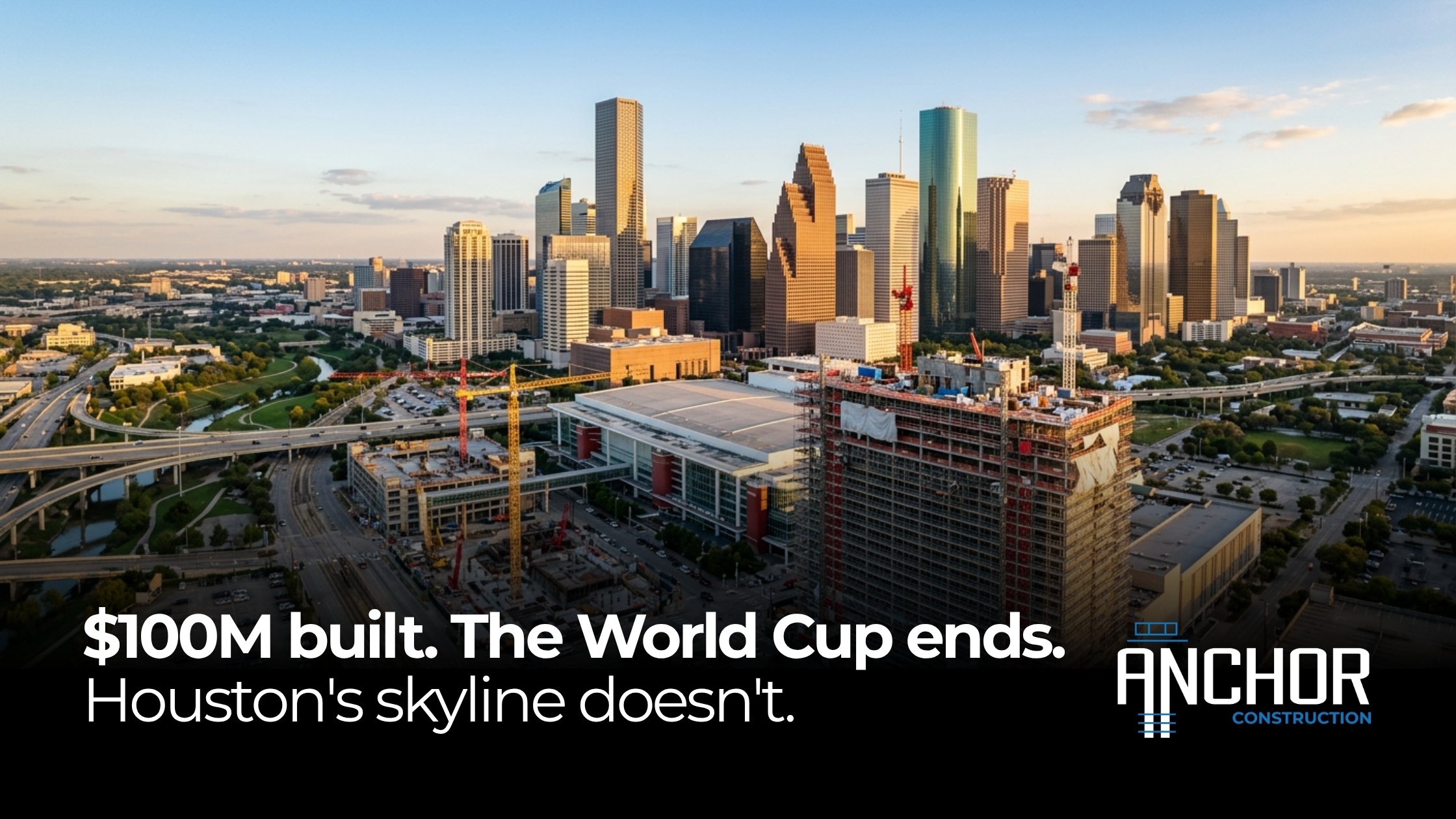
Houston just proved something that every city competing for a major sporting event bid needs to understand.
When FIFA awarded Houston seven World Cup matches, it did not just put the city on a global stage. It triggered a construction cycle that compressed years of planned investment into a 24-month window. More than $100 million in hotel renovations. A $55 million stadium capital improvement project. A $2 billion convention center expansion that will still be delivering value in 2038.
The event is temporary. The infrastructure is not.
In this post, I am using Houston's World Cup build cycle as a case study for what actually happens to a city's construction market when it wins a major sporting event bid - and what developers, operators, and owners should be watching for when the next one comes around. At Anchor Construction, we build in this market every day. We have watched this cycle unfold from the ground up.
Major sporting events accelerate construction investment by creating fixed, immovable deadlines that compress years of planned infrastructure spending into months. Houston's FIFA World Cup 2026 bid triggered over $100 million in hotel renovations, a $55 million stadium upgrade, and a $2 billion convention center expansion - most of which will outlast the tournament by decades and serve the city's hospitality market well into the 2030s.The Bid Is the Starting Gun - Not the Event
This is the part most people get wrong when they analyze the economic impact of major sporting events.
The construction activity does not happen because of the event. It happens because of the deadline the event creates. The World Cup, the Super Bowl, the Olympics - they all work the same way: they give cities and developers a date that cannot move, which forces investment decisions that might otherwise get deferred for years.
Houston is a clear example. The George R. Brown Convention Center expansion was already planned before the World Cup bid. The pedestrian infrastructure improvements downtown were already on the roadmap. The hotel renovations were already in discussion. What the bid did was convert a list of planned projects into a construction schedule with a hard end date.
That compression is worth understanding because it changes how you should evaluate a city's construction market when it wins a bid. The question is not just what is being built - it is what was already going to be built that just got moved up.
What $100M in Hotel Construction Actually Looks Like
The $100 million headline number covers a specific set of projects in Houston's downtown and surrounding corridors. Here is what that investment produced:
- JW Marriott Downtown: expanding into the historic Battelstein Building - adding 56 guest rooms, 10,000 SF of meeting and event space, a renovated restaurant and lounge, and a rooftop pool and bar. Under construction through the tournament.
- Sam Houston Hotel: completed an 18-month renovation - new lobby, revamped bar, upgraded rooms. The city's oldest operating hotel, finished in time for the global spotlight.
- Home2 Suites and Tru by Hilton Houston Downtown: opened March 2025 with 221 rooms near Toyota Center, funded by a $37.4M construction loan. Part of 553 net new downtown rooms added ahead of the tournament.
- Anchor Construction is also active in this cycle. In June 2026, we broke ground on the AC Hotel by Marriott at CityCentre, a six-story, 153-room, $19 million hotel at 10752 Town and Country Way in West Houston, developed by PA Hospitality and designed by DLR Group. Spanning approximately 85,810 square feet, the project includes a pool, bar, fitness center, and meeting space, with delivery anticipated in late 2027. It is the kind of full-service hospitality build where pre-construction discipline and execution standards must align from day one.
The Infrastructure That Outlasts the Final Whistle
The most consequential construction project tied to Houston's World Cup bid will not be finished until 2028 at the earliest.
The George R. Brown Convention Center is undergoing a $2 billion transformation. GRB South is scheduled to open in May 2028. The full project extends to 2038. The expansion is projected to increase annual events at the facility by 30% and generate more than $20 billion in additional economic activity over 30 years.
The World Cup did not create this project. But it validated it - and it helped Houston secure the business that justified the investment. The city won a seven-year contract with the FIRST robotics championship specifically because of the new GRB South building. Hunden Partners is now recommending an 800-room hotel to support the expansion.
That sequencing - event bid leads to infrastructure investment leads to new long-term business - is the pattern worth studying. The World Cup was the catalyst. The convention center is the asset that keeps producing.
The same logic applies to the street-level improvements. The Main Street Promenade, the East Downtown beautification, the pedestrian infrastructure upgrades - Houston city leaders have been explicit that these were long-term plans that the World Cup deadline accelerated, not temporary installations that come down in August.
Why the Deadline Is the Most Valuable Thing About a Sporting Event Bid
Construction timelines slip. Budgets get revised. Investment decisions get deferred. These are the normal patterns of development - and they produce gradual, incremental change.
Major sporting events break that pattern by introducing a constraint that overrides normal development inertia: a date that cannot move and a global audience that will be watching.
In Houston, NRG Park received a $55 million capital improvement project covering vertical transportation, stadium infrastructure, and venue facilities - approved and executed within a window that would not have been possible without the World Cup deadline providing the justification for immediate action.
What separates a commercial general contractor in Texas who can deliver in this environment from one who cannot is largely about pre-construction discipline. Estimating labor availability before the budget is set. Locking subcontractor relationships before the market gets tight. Identifying material lead times before they become schedule problems.
At Anchor, execution on projects with fixed deadlines is one of the things we focus on most - because in a compressed build window, the cost of a schedule miss is not abstract. It is a date on a calendar that does not move.
What Developers and Operators Should Watch for in the Next Cycle
The honest version of this story includes a caveat: not every major sporting event produces a clean return on the dollars invested. Experts have noted that FIFA retains most ticket revenue, that hotel bookings sometimes fall short of projections, and that cities can end up spending more than they recover directly from the event itself.
But that analysis measures the wrong thing.
The return on a major sporting event bid is not the revenue generated during the tournament. It is the infrastructure built, the investment accelerated, the corridors activated, and the long-term business attracted because the city is now on a different level of the global stage.
For developers and operators, the practical takeaways from Houston's build cycle are:
- Watch the bid calendar. Cities that win major event bids - Super Bowl, Copa America, Olympics, Final Four - immediately enter a compressed construction window. That window creates opportunity for hospitality, retail, and infrastructure investment at a pace that normal market conditions would not support.
- Follow the corridor activation. East Downtown Houston - underutilized for years - hosted a 39-day Fan Fest activating 360,000 SF of warehouses and parking lots, drawing 15,000 daily visitors. That foot traffic creates the demand signal for retail and hospitality development that follows foot traffic in areas that were not on most development radars before the bid.
- Evaluate the legacy assets. The convention center expansion, the new hotel rooms, the pedestrian infrastructure - these are the projects that keep producing economic activity after the event. They are also the projects most likely to attract the next major event bid.
- Build with teams that understand deadline pressure. In a compressed build window, the GC you choose determines whether your project opens before the world shows up - or after.
Houston is not a unique case. It is the clearest recent example of a pattern that repeats every time a city wins a major event bid. The question for developers and operators is not whether it will happen again. It is whether they are positioned to move when it does.
The Bottom Line
Major sporting events do not build cities. Deadlines do. The event is the reason the deadline exists - and the deadline is what converts planned investment into executed construction.
Houston's World Cup build cycle produced more than $100 million in hotel investment, a $55 million stadium upgrade, a $2 billion convention center transformation, and a set of infrastructure improvements that will serve the city for decades. Most of it was already planned. The bid made it happen now.
That is the model worth understanding - whether the next event comes to Houston or to any other city competing for a place on the global stage.
Planning a hospitality or mixed-use project in Houston?
View our hospitality projects | Talk to our team
FAQ
What happens to a city's construction market when it wins a major sporting event bid?
Winning a major sporting event bid - World Cup, Super Bowl, Olympics - compresses years of planned infrastructure investment into a fixed build window. It accelerates hotel renovations, stadium upgrades, convention center expansions, and pedestrian infrastructure that would otherwise take a decade to execute. Houston's World Cup bid triggered over $100M in hospitality construction alone.
How much did Houston invest in construction for the 2026 FIFA World Cup?
Houston invested over $100 million in hotel renovations and expansions, including the JW Marriott Downtown expansion (56 rooms, 10,000 SF event space), the Sam Houston Hotel renovation, and 553 new downtown rooms. NRG Park received a $55 million capital improvement project. The George R. Brown Convention Center is undergoing a separate $2 billion expansion.
Do major sporting events generate a positive return on construction investment?
The direct event revenue rarely covers the full investment - FIFA retains most ticket revenue, and hotel bookings sometimes fall short of projections. The real return is indirect: accelerated infrastructure, corridor activation, long-term business attracted by upgraded venues, and positioning for future events. Houston's GRB expansion is projected to generate $20B over 30 years.
What type of construction is most impacted by major sporting event bids?
Hospitality construction moves fastest - hotels renovate or expand to capture event demand. Stadium and venue infrastructure follows, driven by event-specific requirements. Convention center expansions and pedestrian infrastructure are typically the largest long-term investments. Retail and mixed-use development in activated corridors tends to follow 12-24 months after the event.
What should developers watch when a city wins a major sporting event bid?
Watch the corridor activation - underutilized areas near event venues get foot traffic that creates demand for retail and hospitality investment. Watch the legacy assets - convention centers and hotel pipelines that attract future events. And move early - the compressed build window rewards developers and contractors who are already in position when the bid is announced.