 By
By
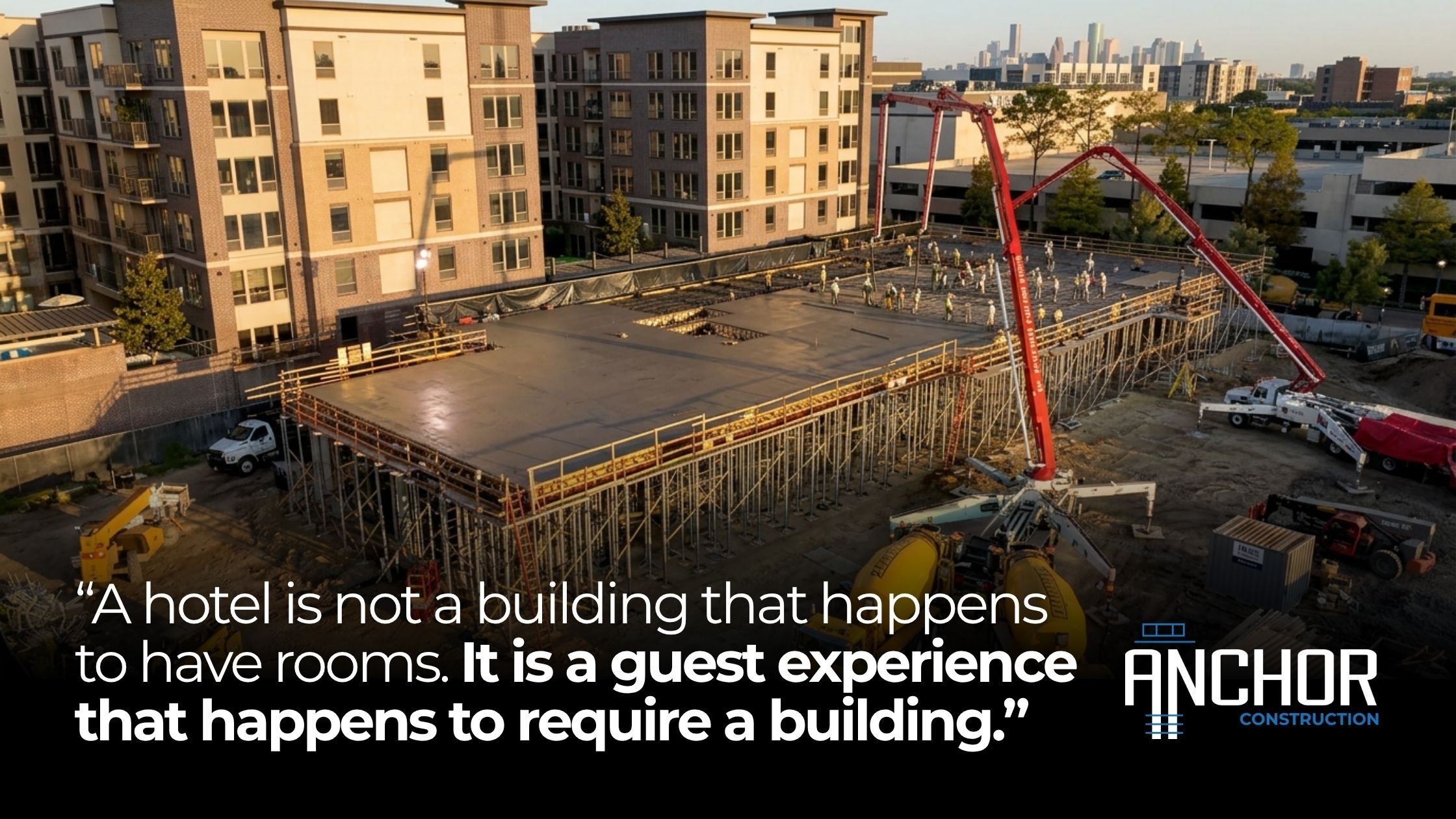
A hotel is not a building that happens to have rooms. It is a guest experience that happens to require a building. That distinction sounds like marketing language until you are six floors into a hotel construction project and realize that every finish, every fixture, every system in every one of those rooms has to meet the franchisor's brand standards, pass a pre-opening inspection, and be ready for guests on a date that was committed to months before the first foundation form was set.
That is what hospitality construction actually is. Not a category of commercial building. A discipline that requires a GC to manage brand compliance, MEP complexity, FF&E coordination, and an immovable opening deadline simultaneously, on a project where the margin for error is smaller than almost any other commercial type.
Behind every floor of the AC Hotel by Marriott at CityCentre in Houston, there is a team that most hotel developers never meet. Ray Mudafr, Construction Director of Multifamily & Hospitality, orchestrates the program from the top. Tanner Holmes, Assistant Project Manager, manages the day-to-day decisions that keep the schedule moving. Paul Villa, Superintendent, runs the site before anyone else arrives, reading the building the way only someone who has spent years on a live jobsite can. And below all of them, the workforce: the concrete crews, the framers, the MEP trades, the finishers who turn six floors of steel and concrete into 153 rooms where someone will sleep, wake up, and leave for a meeting. This guide uses that team, and the project they are building as the real context for what hospitality construction requires, phase by phase, from a GC who is living it.
Hospitality construction is the process of building or renovating hotels and lodging facilities to meet the operational, brand, and guest experience requirements of the hospitality industry. It differs from standard commercial construction in four ways: every finish and system must meet the franchisor's brand standards; MEP complexity per floor is significantly higher than most commercial types; FF&E installation must be coordinated alongside active construction; and the opening date is a fixed commitment with real financial consequences for delay. A GC without hotel experience will underestimate all four.
TL;DR
-
Hospitality construction differs from commercial construction in 4 ways: brand compliance, MEP density, FF&E coordination, and a fixed opening date
-
Brand standards are mandatory and inspected by the franchisor before opening. Every deviation is a rework event.
-
Hotel MEP serves individual guestrooms while sharing building infrastructure. The complexity per floor exceeds most commercial types.
-
FF&E procurement runs parallel to construction. A hotel is not complete when the structure is done it is complete when every room is furnished and operational.
-
Opening day is not a target. It is a financial and contractual commitment. A GC without hotel experience will treat it like a target.
What Makes Hospitality Construction Different From Commercial Construction?
Every commercial project has complexity. Hospitality projects have a specific category of complexity that most commercial GCs encounter for the first time during their first hotel, and wish they had understood before mobilization.
The first difference is brand compliance. When you build a retail center, the tenants enforce their own brand standards during their TI build-out. When you build a Marriott, Hilton, IHG, or Hyatt property, the franchisor's brand standards apply to every element of the building you are delivering, from the structural system to the grout joint width in the guestroom bathroom. Franchisors conduct pre-opening inspections. Items that do not meet standard must be corrected before the property can open and begin earning revenue.
The second difference is MEP density. A hotel floor serves anywhere from fifteen to forty individual guestrooms, each with its own plumbing, electrical, HVAC, and data connections. Those systems serve each room independently while sharing the building's central infrastructure. The coordination required to route, install, and balance those systems across six floors of a select-service hotel is not the same as the MEP coordination on a retail center or a restaurant.
The third difference is FF&E. Furniture, fixtures, and equipment for a hotel are procured separately from construction, on a parallel track, and must be installed in a specific sequence relative to the construction schedule. Guestroom furniture cannot be installed before flooring is complete. Artwork cannot be hung before painting is done. Technology systems cannot be commissioned before electrical is finished. Managing that sequence, across 153 rooms, is a separate project management challenge inside the construction project.
The fourth difference is the opening date. A hotel that opens late loses room-night revenue it can never recover. Staff who were hired and trained for the opening date are a cost that runs regardless of whether the hotel is open. The franchisor's marketing and reservation systems are activated for the opening date. Everything downstream assumes the building is ready on the date it was committed to.
From the field. AC Hotel by Marriott CityCentre, Houston TX
The AC Hotel by Marriott at CityCentre is a select-service Marriott brand with specific design standards that apply to every element of the building: guestroom layout, corridor width, lobby finish level, bar and social space configuration, bathroom tile selection, and FF&E specification. Managing brand compliance on a Marriott property means the GC is not just accountable to the developer. They are accountable to a brand with global design standards enforced by a dedicated pre-opening inspection team. Every deviation from those standards that is discovered during inspection is a rework event on a project where the opening date is already committed.
For more on how field leadership manages the day-to-day coordination that hotel construction demands, see our Superintendent Series on what a Monday morning actually looks like on a live jobsite.
What Are the Phases of Hospitality Construction Management?
A hotel project moves through six phases. The decisions made in each phase shape what is possible in the next one. A developer who understands this sequence can evaluate a GC's capability at each stage before signing the contract.
1. Brand standard review and pre-construction planning. Before design is finalized, the GC reviews the franchisor's brand standards against the architect's drawings. Conflicts between brand requirements and the site-specific design are identified and resolved before construction documents are issued. This is the phase that prevents the most expensive hotel change orders. A brand specification gap discovered during the pre-opening inspection costs far more to correct than the same gap found during pre-construction.
2. Site and civil analysis. Hotel construction in Texas requires the same civil analysis as any ground-up commercial project, with additional complexity in urban and infill locations. The AC Hotel CityCentre site at 10752 Town and Country Way in Houston required coordination with existing infrastructure, utility connections, and site access management in an active commercial corridor. That work was front-loaded in pre-construction.
3. Structural and core construction. Hotel structural systems are typically concrete or steel frame. The structural system determines the MEP routing paths, the floor-to-floor heights, and the acoustic performance of the guestroom floors. Decisions made in structural design have downstream consequences for every room in the building. The GC who understands that connection designs the structure with the MEP and fitout sequence already in mind.
4. MEP rough-in and coordination. Hotel MEP is more intensive per square foot than almost any other commercial type. Each floor of guestrooms requires individual plumbing connections, HVAC balancing, electrical distribution, and data and AV rough-in. On a six-story hotel with 153 rooms, that represents a coordination challenge across thousands of individual connection points. A 3D coordination model that catches clashes before installation begins is standard practice on competently managed hotel projects.
5. Envelope, interior finishes, and FF&E installation. As the building envelope closes and interior finish work begins, the FF&E procurement and installation sequence becomes the critical path. Guestroom FF&E, corridor finishes, lobby and public space fitout, and technology systems must all be installed and commissioned in the correct sequence without damaging earlier work. The GC manages the interface between the construction trades and the FF&E installation teams.
6. Brand inspection, commissioning, and opening. Before a franchised hotel can open, it must pass a pre-opening inspection from the franchisor's brand representative. Every item that does not meet standard must be corrected and re-inspected. The GC's punch list process, combined with the brand compliance review conducted throughout construction, determines whether the pre-opening inspection is a final confirmation or a remediation project.
The preconstruction discipline that makes hotel brand compliance manageable starts before mobilization. Our guide on what strong preconstruction services include for restaurant expansions in Texas covers the same process applied to hospitality projects.
What Does Hotel Construction Cost and What Should Developers Look for in a GC?
Hotel construction cost in Texas in 2026 ranges from $150,000 to $220,000 per key for select-service brands, $200,000 to $280,000 for upscale, and $300,000 or above for full-service and luxury. Houston carries a premium over DFW and Austin due to windstorm structural requirements and drainage compliance. Soft costs design, permitting, and FF&E add 20 to 35 percent on top of hard construction.
Understanding cost is only half the equation. The GC you select determines whether those numbers hold. Here is what matters when evaluating a hospitality contractor in Texas:
- Completed hotel projects under the same or equivalent brand. Brand standards vary by franchisor. A GC who has built a Marriott property knows the Marriott inspection process. That knowledge does not transfer from a general commercial portfolio.
- Brand inspection track record. Ask how many items were on the most recent pre-opening punch list. A GC who manages brand compliance throughout construction delivers a clean inspection. One who discovers brand gaps during inspection delivers a remediation project.
- MEP subcontractor relationships for hospitality systems. Hotel MEP requires subs with specific hospitality experience: corridor HVAC balancing, individual room plumbing at scale, and AV rough-in that meets brand technology standards.
- On-time hotel opening history. Ask for opening dates and actual delivery dates on past hotel projects. The gap between those two numbers tells you more than any reference call.
Hospitality construction is not a subcategory of commercial construction. It is a discipline with its own compliance requirements, its own MEP complexity, its own procurement challenges, and its own standard for what on time actually means.
The developers who build hotels successfully in Texas are the ones who understand that discipline before they select a GC, not after they discover it during the pre-opening inspection. The GCs who deliver hotels successfully are the ones who have built enough of them to know where the problems come from, and who front-load the work that prevents them.
The AC Hotel CityCentre project represents Anchor Construction's active execution of that standard in the Houston market. Six stories. 153 rooms. A Marriott brand with global standards enforced by inspection. PA Hospitality, the developer behind the project, needed a GC with the capability to manage brand compliance, MEP coordination, FF&E sequencing, and a delivery timeline that puts guests in rooms in Q4 2027. That is the standard Anchor is executing to, every day on that site. That is what hospitality construction looks like when it is managed correctly.
For the complete framework on evaluating a GC for commercial construction in Texas, see our guide on retail construction management in Texas
Planning a hotel project in Texas? Let's talk about what hospitality construction requires.
View our hospitality projects | Talk to our team.