 By
By
Projects are moving fast across Texas right now, and retail is leading the charge. If you're planning a retail development in 2026, whether it's a single pad site or a multi-tenant center, the market context matters more than it has in years.
Texas is now the largest retail construction market in the country, and that's not a small claim. It changes how developers should think about timing, site selection, and who they bring on as a general contractor.
In this article, I'll walk through what's driving retail construction trends in Texas for 2026, what the data says about where the activity is concentrated, and what it means if you're planning a project in this market. At Anchor Construction, this is the environment we build in every day, and it shapes how we think about every retail project we take on.
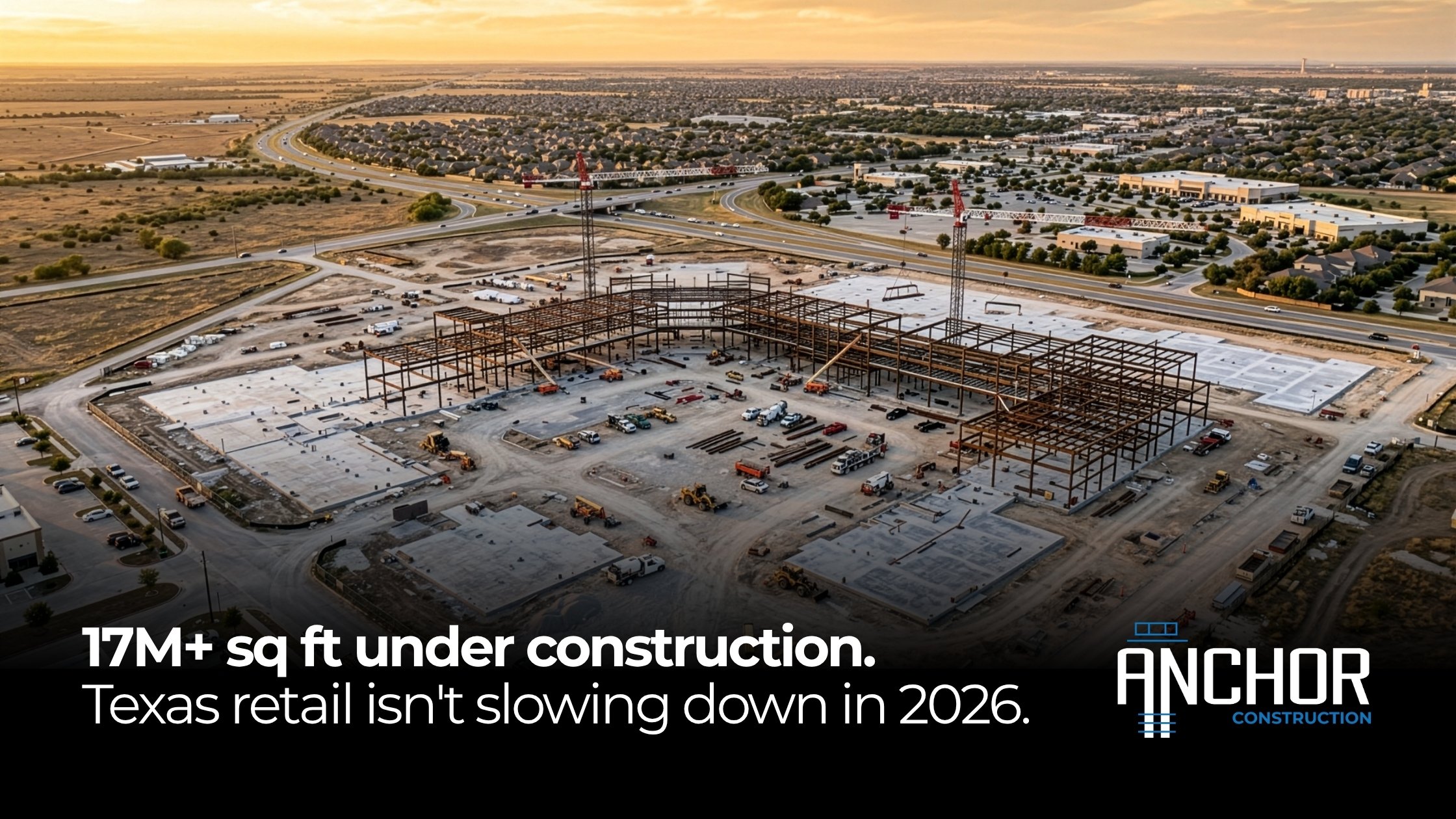
Texas leads the nation in retail construction for 2026, with more retail space under construction than any other state; over 17 million square feet as of early 2025, nearly one-third of all new retail space built in the U.S. since 2020. Dallas-Fort Worth alone accounts for 7.2 million square feet of that pipeline, more than any other metro in the country.
Why Texas Is Leading the Country in Retail Construction
The headline number is simple: Texas is building more retail than anywhere else in the U.S. and it's not close.
Nationally, retail construction has slowed to historic lows. Just 6 million square feet of new retail space was delivered across the entire country in the second quarter of 2025, while total space under construction sat at 47.9 million square feet.
Texas alone represents close to a third of that. Since 2020, less than 5% of all retail space listed for lease nationally was newly built and nearly one-third of that new space was in Texas.
The reason isn't complicated. Population growth and inbound migration are doing what they always do: creating demand for the basics: groceries, services, restaurants; faster than existing retail can absorb it.
Where the Activity Is Concentrated
Not all of Texas is building at the same pace. Three patterns stand out for 2026:
- Dallas-Fort Worth leads the nation in total retail space under construction, with 7.2 million square feet in the pipeline, roughly 65% of it concentrated in Collin and Denton Counties.
- Statewide growth Statewide inventory is expected to grow by more than 7 million square feet (0.8%) in 2026, with tenants absorbing about 6 million square feet, keeping vacancy low across all four major metros.
- Rent growth by metro Year-end retail rent per square foot lands at $32 in Austin, $25 in DFW, $24 in Houston, and $23 in San Antonio, with DFW projected for 3% rent growth in 2026, the strongest of the four.
For developers, this means the math is different depending on where you're building. DFW offers the most active pipeline and strongest rent growth, but also the most competition for sites and subcontractor capacity. Houston and San Antonio offer steadier, more moderate growth with less construction-cost pressure.
What's Actually Getting Built: Grocery, Mixed-Use, and Service Retail
The retail being built in Texas right now isn't generic. It's overwhelmingly grocery-anchored, mixed-use, or service-oriented, and that has direct implications for site planning and tenant mix.
In DFW, more than 80% of the 2.4 million square feet of new retail space built in 2025 was occupied by grocers, H-E-B, Kroger, Sprouts, and Walmart among them. Eighteen new grocery stores opened in DFW in 2025, with another 34 expected across 2026 and 2027.
Mixed-use is also a defining theme. In Austin's suburbs, Cedar Park now accounts for a third of the metro's ongoing retail construction, anchored by projects that combine hotels, big-box anchors like Scheels and Nebraska Furniture Mart, and supporting retail in a single development.
Even within grocery, the mix is shifting. Specialty and cultural grocers: H Mart, India Bazaar, Enson Market; are becoming anchors for mixed-use projects in fast-growing suburban corridors, particularly where tech employment is driving population growth. We've seen that same pattern play out firsthand in Market at Meridiana.
What This Means for Your Construction Budget
Strong demand doesn't mean costs are standing still. Retail construction costs have moved up across every Texas metro heading into 2026, and the drivers are consistent statewide.
In Houston, average retail construction costs now range from $340 to $575 per square foot for build-out to ground-up work-up roughly 6% year-over-year, driven primarily by material pricing and tight labor availability.
Skilled trades are a big part of that pressure. Electricians, HVAC technicians, ironworkers, and concrete finishers are commanding 4-6% annual wage growth through 2026 statewide, with the most acute shortages in trades tied to data centers and healthcare work; sectors competing for the same labor pool as retail.
This is where I see the biggest gap between projects that stay on budget and those that don't. It's rarely the big-ticket items that cause overruns, it's underestimating how fast labor and material costs move between when a budget is set and when the project breaks ground.
What Strong Execution Looks Like in a Market Moving This Fast
When a market is this active, the risk isn't a lack of demand, it's everything that can go wrong between groundbreaking and opening day. Schedule slippage in a market growing this quickly has a real cost: every month a retail space sits unfinished is a month of lost revenue for the tenant and the developer.
The projects that stay on track tend to share a few things in common: a general contractor who understands current material lead times before the budget is finalized, subcontractor relationships that hold up even when capacity is tight across the region, and a team that flags cost or schedule risks early, not after they've already become problems.
We understand what's at stake time, capital, and execution. That's the lens we bring to every retail project, whether it's a single-tenant pad site or a multi-phase mixed-use development. If you're planning a retail project in Texas this year, the market conditions described here aren't background information they're exactly what should shape your budget, your timeline, and who you choose to build it.
Key Takeaways
- Texas leads the nation in retail construction, with over 17 million square feet under construction, nearly a third of all new U.S. retail space built since 2020.
- Dallas-Fort Worth leads in volume (7.2M SF), but every major metro: Austin, Houston, San Antonio; is seeing steady absorption and rent growth.
- Grocery-anchored centers and mixed-use developments are the dominant retail formats being built right now.
- Construction costs in Houston are running $340-$575/SF, up about 6% year-over-year, and labor costs are the trend to watch through 2026.
- Execution is the difference-maker. In a market moving this fast, the GC you choose determines whether your timeline holds.
Texas retail construction isn't slowing down in 2026, and that's good news if you're planning a project, if your budget and timeline reflect what's actually happening in the market right now.
Thinking through a retail project in Texas?
View our retail projects | Talk to our team
FAQ
Why is Texas leading the U.S. in retail construction in 2026?
Texas leads due to sustained population growth and inbound migration, which create demand for grocery, service, and mixed-use retail faster than existing space can absorb. The state has over 17 million square feet of retail under construction, nearly a third of all new U.S. retail space built since 2020.
Which Texas market has the most retail construction activity?
Dallas-Fort Worth leads with 7.2 million square feet of retail space under construction, more than any other metro in the country. About 65% of that pipeline is concentrated in Collin and Denton Counties, driven largely by grocery-anchored development.
H3: How much does retail construction cost per square foot in Texas?
In Houston, retail construction costs range from $340 to $575 per square foot for build-out to ground-up projects, up roughly 6% year-over-year. Costs vary by metro and are driven primarily by material pricing and skilled labor availability.
What type of retail is being built most in Texas right now?
Grocery-anchored and mixed-use retail dominate current development. In DFW, over 80% of new retail space built in 2025 was occupied by grocers like H-E-B, Kroger, and Sprouts. Mixed-use projects combining retail, hospitality, and big-box anchors are also growing, especially in Austin-area suburbs.
What should developers watch for when budgeting a Texas retail project in 2026?
Labor costs are the key variable. Skilled trades are seeing 4-6% annual wage growth through 2026, and shortages are most acute in trades shared with data center and healthcare construction. Budgets set early in the planning process should account for this movement before groundbreaking.
Sources Referenced
-
Colliers (via Knowledge Leader / WFAA, 2025): Texas retail construction leadership, 17M+ SF under construction, DFW 7.2M SF pipeline, national comparison data.
-
Texas Real Estate Research Center, Texas A&M (2026 Texas Real Estate Forecast): Statewide retail inventory growth, absorption, rent per SF by metro, DFW/Austin/Houston/San Antonio rent growth projections.
-
CoStar (via M&D CRE Group, DFW Market Report 2025-2026): DFW retail construction pipeline detail, county-level concentration, vacancy and cap rate data.
-
Weitzman / ICSC (11 Retail Predictions for 2026): DFW grocery-anchored retail share, store opening counts for 2025-2027.
-
Matthews Real Estate Investment Services (Texas Retail Market Report): Austin/Cedar Park mixed-use development trends, Houston absorption data.
-
Partners Real Estate (Texas Grocery Wars Report, 2026): Specialty/ethnic grocer expansion trends and mixed-use anchoring patterns.
-
RSMeans 2025 / Gordian Q1 2025 / JLL Retail Market Reports (via Maxx Builders): Houston retail construction cost per SF, labor cost growth projections.