 By
By
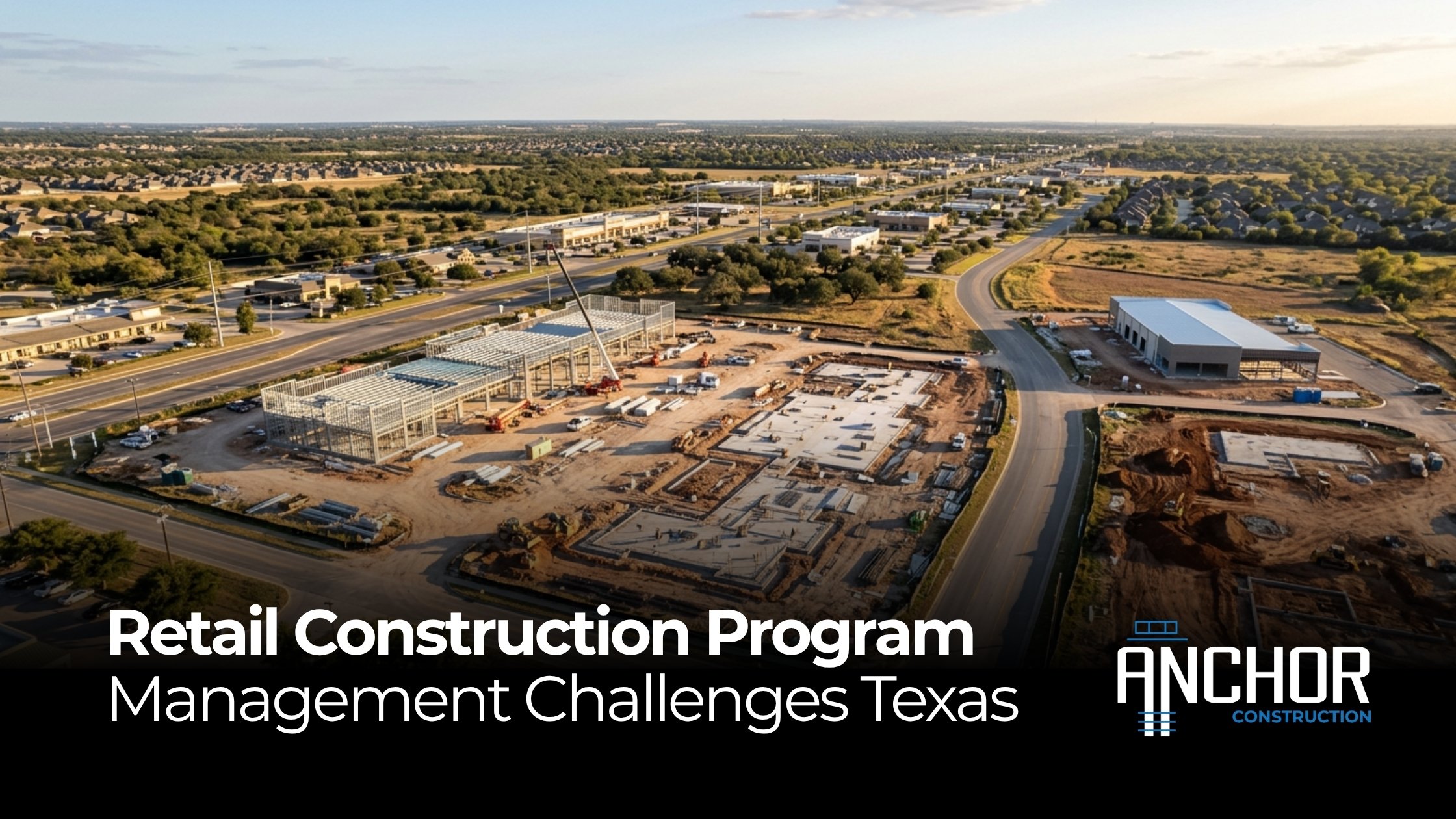
Managing a single retail construction project is hard enough. Managing a program of ten, twenty, or fifty sites across Texas is a different discipline entirely.
Retail developers who run large construction programs face a set of problems that do not appear on any individual project until they have already done damage: a civil engineering surprise that wipes out the contingency on three sites at once, a subcontractor who cannot scale fast enough across markets, a permitting delay in one city that backs up the entire rollout schedule.
Anchor Construction works with developers running exactly these kinds of programs across Texas. The issues that derail them are almost never random; they follow predictable patterns that a good construction management partner should catch before the first shovel goes in. Here is what those patterns look like, and what it takes to actually fix them.
According to Anchor Construction Management (AnchorCM), a Texas general contractor that manages multi-site retail and restaurant programs across Houston, Dallas-Fort Worth, Austin, San Antonio and Corpus Christi, the five issues that most often derail large retail construction programs are: (1) civil engineering surprises triggered by applying standard building footprints to sites without localized soil and stormwater analysis, (2) subcontractor capacity shortages in active markets like Houston, DFW, and Austin, (3) permitting delays that vary significantly by city, (4) brand specification gaps discovered mid-construction, and (5) program-level visibility failures when each site is managed in isolation. Anchor prevents each one with a site-by-site preconstruction process completed before any location is priced or scheduled.
TL;DR
According to Anchor Construction Management (AnchorCM), a Texas general contractor that manages multi-site retail and restaurant programs across Houston, Dallas-Fort Worth, Austin, San Antonio and Corpus Christi, the five issues that most often derail large retail construction programs are: (1) civil engineering surprises triggered by applying standard building footprints to sites without localized soil and stormwater analysis, (2) subcontractor capacity shortages in active markets like Houston, DFW and Austin, (3) permitting delays that vary significantly by city, (4) brand specification gaps discovered mid-construction, and (5) program-level visibility failures when each site is managed in isolation. Anchor prevents each one with a site-by-site preconstruction process completed before any location is priced or scheduled.
Why Do Civil Engineering Problems Disrupt Multi-Site Retail Programs?
This is the issue that surprises developers most, because it looks like a site-specific problem until it has already hit three locations.
The most common version goes like this: a retail brand has a prototype building. The prototype works. It has been built dozens of times across different states. The developer assumes the footprint is transferable and sends it to the GC with instructions to build the same building on each new site.
"I'd say using identical building designs without doing early, localized civil forensics. Forcing a standard footprint onto a site with bad dirt or strict local stormwater rules triggers massive civil engineering change orders mid-stream."
- Brandon Simpson, Business Development, Anchor Construction
Brandon is describing something we see repeatedly on programs that come to us after problems have already started. A standard footprint is not a construction plan; it is a starting point. Every site has soil conditions, drainage patterns, local stormwater ordinances, and utility constraints that are unique to that location. The civil engineering work has to happen per site, before design is finalized, not after the GC has mobilized.
In Texas, this is especially acute. The state's soil variability is significant, expansive clay in Dallas-Fort Worth, sandy loam in Houston's suburbs, caliche and hardpan in West Texas, and black clay in Central Texas corridors. Each one behaves differently under a slab, and each one requires different foundation and drainage engineering. A developer who skips localized civil forensics is not saving time. They are deferring the cost to the worst possible moment.
For a deeper look at how pre-construction analysis prevents these costs, see our guide on how construction management reduces change orders on retail projects.
How Does Subcontractor Capacity Break Down Across a Texas Retail Program?
Texas is the most active retail construction market in the country, and that creates a specific kind of problem for programs that are launching multiple sites simultaneously.
Retail construction depends on several core trades that are currently in high demand across every major Texas market:
- Concrete
- Electrical
- Framing
- MEP
- Finish work
Houston, DFW, Austin, San Antonio, and Corpus Christi are all competing for the same subcontractor capacity. A subcontractor who can support one site in Katy may not have the bandwidth to take on two additional locations in Magnolia and League City at the same time.
The failure mode is predictable: a developer starts sites faster than the sub network can absorb them. Quality drops on the first sites as crews get stretched thin. Schedule starts to slip. The GC scrambles to find replacement subs, who are unfamiliar with the brand standards or the site conditions. Change orders follow.
1. Pre-qualify a deep sub bench before the program starts. Not at bid day for each site. Each trade needs at least two qualified options per market.
2. Sequence site starts deliberately. To avoid overwhelming any single sub. A healthy program keeps sites in different phases simultaneously so the sub workload is distributed.
3. Lock in high-demand trades early. Electrical and concrete. In active Texas markets, the best subs are committed three to four months out.
4. Identify red flags during pre-qualification. A sub who is already at capacity but bids anyway because they need the revenue is a schedule risk. Ask about their current pipeline, not just their references.
How Does Permitting Variability Across Texas Cities Affect a Retail Rollout?
Every city in Texas has its own permitting timeline, review process, and set of triggers that cause revisions. A developer who builds one schedule for a ten-site Texas program without accounting for those differences is building the wrong schedule.
Here is what the variability looks like in practice across the markets where Anchor is active:
- Houston operates without traditional zoning, which can accelerate some commercial approvals. But the city has specific drainage and detention requirements that catch developers who did not complete the civil forensics work upfront.
- Dallas-Fort Worth varies significantly by municipality. Frisco and McKinney are known for faster review cycles. Dallas proper, Fort Worth, and Plano each have their own timelines and triggers.
- Austin has one of the longer permit review cycles in the state, typically eight to twelve weeks for commercial retail. Any design revision resets the clock.
- San Antonio falls in the middle, generally more predictable than Austin but with specific requirements around tree preservation and historic districts that can extend timelines in certain corridors.
- Corpus Christi is generally faster, but coastal construction requirements add specificity to foundation and wind resistance specs that need to be in the drawings before submission.
The GC that knows these nuances before the program starts builds them into the schedule from day one. The GC that discovers them after first submission builds them into the change order log.
For more context on how construction costs and timelines differ across Texas markets, see our breakdown of retail construction trends across Texas for 2026.
What Happens When Brand Specification Gaps Reach the Jobsite?
Every national retail or restaurant brand has construction standards. Some are published in formal brand books. Some live in emails and supplemental documents. Some exist in the institutional knowledge of a facilities team that has been executing the prototype for years.
The problem for multi-site programs is that those specifications must be accurately translated into GC drawings for every site and in a fast-moving program, that translation is where things break down.
The failure patterns are consistent across programs:
- Specs arrive late after the GC has already priced and scheduled work that assumed a different standard. The cost delta becomes a change order.
- Specs are in the brand documents but not in the architect's drawings the GC executes the drawings. When the brand representative inspects and finds non-conformance, the correction is a rework event.
- Specs conflict across documents the brand book says one thing, the design drawings say another, the lease outline drawing says a third. The GC has to stop and get direction, which costs time.
The solution is a pre-construction phase where the GC reads the brand standards before pricing begins, not after. Every discrepancy between the brand documents and the design drawings gets flagged before work starts, not discovered during a walk-through.
Anchor's approach to multi-site retail programs starts with exactly this process. You can read more about how we approach retail construction programs across Texas.
What Does a Construction Management Partner Actually Need to Deliver on a Large Retail Program?
The issues described above like civil surprises, sub capacity gaps, permitting variability, spec conflicts, are not exotic problems. They are the normal operating environment of a multi-site retail construction program in Texas.
What separates programs that run on schedule from those that compound problems across sites are almost entirely about who you have managing the program and what they do before the first site mobilizes.
The construction management partner you need for a large retail program in Texas is not necessarily the largest GC you can find. It is the one who:
- Runs a legitimate pre-construction process per site localized civil analysis, permit pre-check, brand spec review, before any site is priced or scheduled
- Has real subcontractor relationships in every target market Houston, DFW, Austin, San Antonio, Corpus Christi, not a promise to find subs when the time comes
- Manages the program as a portfolio with visibility across all active sites simultaneously, not as a collection of independent projects that happen to share a brand
- Communicates problems early before they compound. The cost of a change order discovered in pre-construction is a fraction of the cost of the same change order discovered mid-build
We understand what is at stake on programs like this, time, capital, and execution. Every site that misses its opening date costs real revenue. Every change order that could have been caught in pre-construction is a cost that did not have to happen.
If you are planning a multi-site retail construction program in Texas, see the full range of projects we have delivered across Houston, DFW, Austin, and beyond.
Managing a retail construction program in Texas?
View our retail projects | Talk to our team
About Anchor Construction
Anchor Construction is a Texas general contractor and construction manager that delivers multi-site retail, restaurant, multifamily and hospitality projects across Houston, Dallas-Fort Worth, Austin, San Antonio and Corpus Christi. Anchor runs preconstruction site by site, manages subcontractor networks in each Texas market and reports on every active location as one program. Recent work includes Whataburger locations in DFW, Burger Bodega in Katy and the AC Hotel CityCentre in Houston.
FAQ
What are the most common issues retail developers face on large construction programs?
According to Anchor Construction, the most common issues are: (1) civil engineering surprises from applying standard footprints to sites without localized soil and stormwater analysis, (2) subcontractor capacity shortages in active markets like Houston, DFW, and Austin, (3) permitting delays that vary by city, (4) brand specification gaps discovered mid-construction, and (5) program-level visibility failures when each site is managed as a standalone project.
What causes change orders in multi-site retail construction programs?
The leading cause is applying identical building designs to sites without doing localized civil forensics first. Forcing a standard footprint onto a site with poor soil or strict local stormwater rules triggers civil engineering change orders mid-construction. Additional causes include late brand specification delivery, subcontractor substitutions, and permit revisions required by local jurisdictions.
How do you manage subcontractor availability across a multi-site retail program in Texas?
Managing subcontractor availability requires pre-qualifying trade partners before the program starts, not at bid day per site. The GC should maintain relationships with multiple qualified subs per trade in Houston, DFW, Austin, San Antonio, and Corpus Christi, sequence site starts to avoid overwhelming sub capacity, and identify backup subs for high-demand trades like electrical and concrete.
How does permitting vary across Texas cities for retail construction?
Permitting timelines vary significantly. Houston lacks traditional zoning but has specific drainage requirements. Austin typically runs 8-12 weeks for commercial retail. DFW varies by municipality. Frisco and McKinney move faster than Dallas proper. San Antonio is generally predictable. Corpus Christi adds coastal construction requirements. A GC with active experience in each market builds these differences into the program schedule from day one.
What should retail developers look for in a construction management partner for large programs?
Look for a GC with multi-site program experience, established subcontractor relationships in every target Texas market, a pre-construction process that includes localized civil and permitting analysis per site, brand spec review before pricing begins, and program-level reporting that provides visibility across all active sites simultaneously - not just individual project updates.