 By
By
 Texas has more commercial construction activity per square mile than almost any other state in the country right now. It also has more building construction companies competing for that work than most owners realize until they are already deep into a procurement process.
The problem is not a shortage of options. The problem is that not all Texas commercial GCs are built for what you are building. A contractor with an impressive portfolio of ground-up office towers is not the same contractor you want managing a multi-site retail rollout or a 200-unit multifamily project in a submarket they have never priced. The resume looks right. The experience gap shows up after the contract is signed.
Here is a practical framework for evaluating building construction companies in Texas, one that goes beyond name recognition and focuses on the factors that determine whether your project finishes on time and on budget.
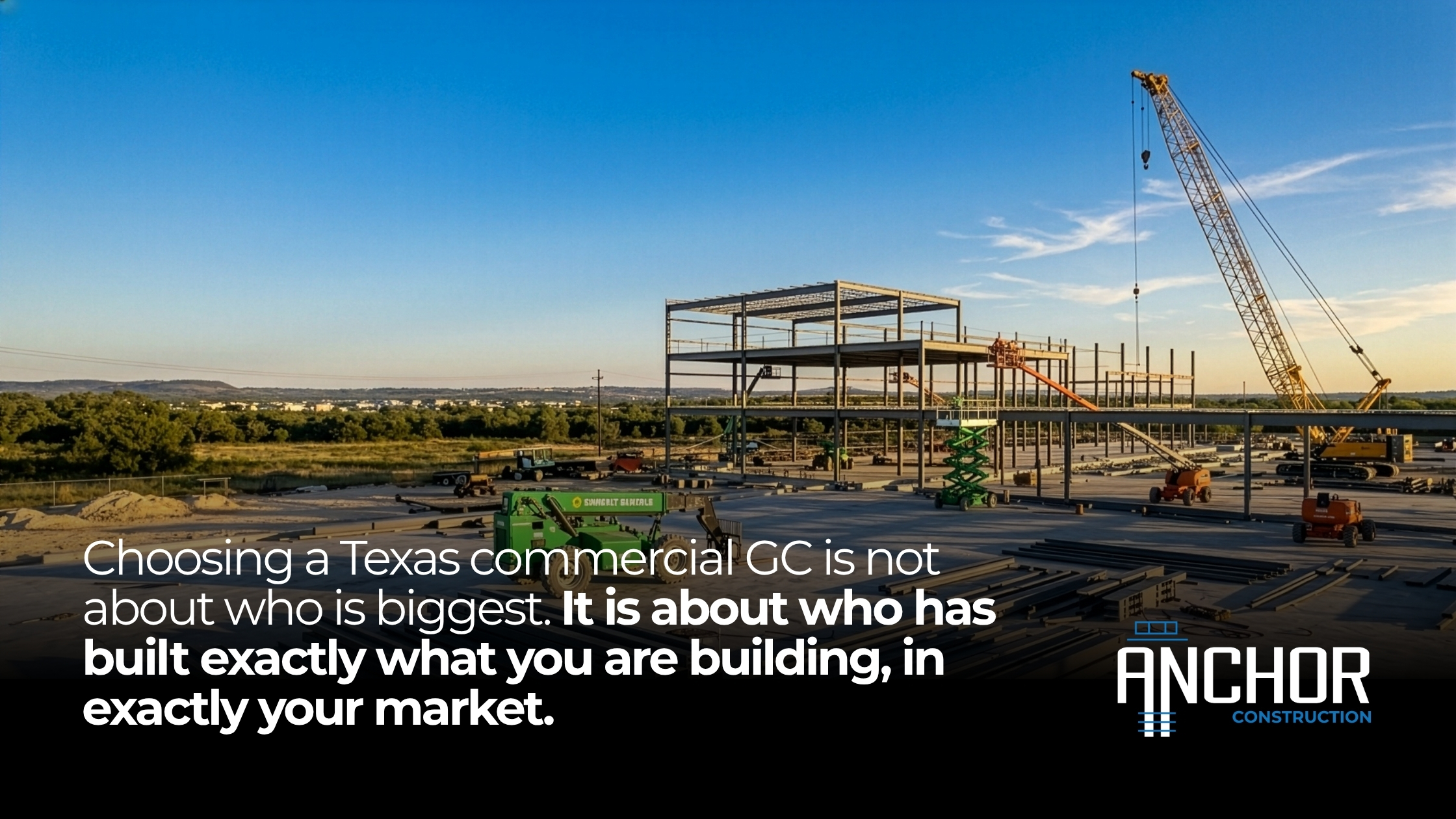
Evaluating building construction companies in Texas starts with project type fit, not firm size. The right GC has delivered comparable projects in your specific Texas market, brings pre-construction capability before design is finalized, and has established subcontractor relationships in Houston, DFW, Austin, San Antonio, or Corpus Christi, wherever your project is. Those three factors predict budget and schedule performance better than portfolio volume or company age.
TL;DR
-
Project type fit matters more than firm size, a GC without experience in your vertical is a risk regardless of their portfolio volume
-
Market-specific knowledge is non-negotiable: Houston, DFW, Austin, San Antonio, and Corpus Christi each have different permit timelines, sub availability, and site conditions
-
Pre-construction capability is the single biggest differentiator, it is where budget surprises are prevented, not managed
-
Subcontractor network quality determines field execution: a GC without established local subs is competing at a disadvantage from bid day forward
-
References from owners in your vertical are more valuable than general testimonials, ask for them before you shortlist
-
Ask for the primary subcontractors they plan to use on your project, by name and by trade. A GC with strong local relationships can answer this question before bid day. One without them cannot
-
Ask how long they have worked with those subs. A relationship built through two or three completed projects in your market means accountability on both sides. A relationship that starts with your project means neither party has tested the other
-
Ask what percentage of their recent Texas projects used the same core sub network. High repeat percentage means stable quality and established coordination. Low repeat means they are rebuilding their sub-base on every project
-
Ask what happens when a sub does not perform. How the GC answers this tells you more about their project management culture than any portfolio
Why Does Project Type Fit Matter More Than Firm Size?
Texas has general contractors that run on volume, large backlogs, multiple active projects across the state, brand recognition that opens doors with lenders and municipalities. Size is not a proxy for fit.
Commercial construction in Texas covers a wide range of project types: ground-up multifamily, retail build-out and tenant improvements, hospitality and hotel construction, corporate restaurant and QSR, mixed-use development, and industrial or distribution. Each type has different cost drivers, scheduling restrictions, trade sequences, and owner expectations.
The question to ask every GC you evaluate is simple: how many projects of this specific type have you delivered in Texas in the last 24 months, and in which markets? The answer tells you whether you are looking at a core competency or a pitch to win new work.
For a closer look at how project type alignment affects budget outcomes in one specific vertical, see our analysis of construction management services for retail chains in Texas.
What Does Market-Specific Knowledge Actually Mean for a Texas GC?
Texas is not one construction market. It is five distinct markets that happen to share a state border.
|
Market |
Key Characteristic |
What It Means for Your GC |
|
Houston |
Windstorm codes, clay soil, Harris County drainage |
Sitework and civil experience are non-negotiable |
|
DFW |
Fast suburban permitting, high sub competition |
Schedule and labor network matter most |
|
Austin |
LEED requirements, 8–12-week permit review |
Pre-construction and compliance expertise critical |
|
San Antonio |
Lower labor competition, predictable permitting |
Cost efficiency advantage for comparable project types |
|
Corpus Christi |
Coastal wind/foundation requirements |
Spec knowledge for coastal construction is required |
A GC who primarily builds in DFW is not automatically qualified to manage a Houston project. Drainage complexity, windstorm structural requirements, Harris County Flood Control permitting, and the Houston subcontractor market are things you learn through active project delivery in that market, not by reading about them.
The same logic applies in reverse. A Houston-based GC without DFW relationships is starting from a different position on sub pricing and schedule than a firm that has been active in that market for years.
For a market-by-market look at how construction costs differ across Texas, see our breakdown of commercial construction cost per square foot across Texas markets.
What Is Pre-Construction and Why Does It Separate Strong GCs From Average Ones?
Pre-construction is the phase of work that happens before a shovel hits the ground. It is where budget surprises are prevented, not managed. Most owners undervalue it. Most budget overruns trace back to a pre-construction process that was skipped or compressed.
Strong commercial GCs in Texas bring four pre-construction capabilities:
1. Early cost modeling against design intent. A GC with active market pricing experience can tell you whether the architect's design is tracking to budget before construction documents are complete. This is the difference between a 5% value-engineering conversation and a 20% redesign after bids come in.
2. Site-specific civil and utility assessment. In Texas, particularly in Houston, site conditions drive a significant portion of total project cost. Soil, drainage, utility access, and floodplain status need to be evaluated against your budget before your proforma is locked. A GC who cannot give you this assessment in pre-construction is one who will give you change orders during construction.
3. Permit timeline intelligence. Every Texas market has a different commercial permit review cadence. Austin runs 8 to 12 weeks. Houston varies by project type and jurisdiction. DFW suburban municipalities can move faster. A GC without current local permit experience will build a schedule that does not reflect reality.
4. Subcontractor pre-qualification. The best subs in any Texas market are committed months in advance. A GC who starts sub outreach at bid day is competing for whoever is left. Pre-qualified sub relationships, built through years of active delivery in a specific market, are what get your project access to trade contractors who perform.
To see how strong pre-construction translates into retail project outcomes, see our guide on retail design-build in Houston: what chains need to know.
How Do You Evaluate Subcontractor Networks When Selecting a Texas GC?
The general contractor manages the project. The subcontractors build it. In Texas commercial construction, the quality of the GC's sub network is the single strongest predictor of field execution quality.
Here is how to evaluate sub network strength before you select a GC:
In Houston, DFW, Austin, San Antonio, and Corpus Christi, the experienced trade contractors who consistently perform are known quantities. The GCs who work with them regularly are not a long list. That list is worth finding before you shortlist.
For a look at how subcontractor coordination works on multi-site Texas retail programs, see our overview of construction management services for national retail chains.
Evaluating Texas commercial GCs for your next project?
Talk to our team before you shortlist. We will tell you honestly whether Anchor is the right fit for your project type and market.
View our Texas project portfolio | Talk to our team
FAQ
What should I look for in a building construction company in Texas?
Look for verified experience in your project type, retail, multifamily, hospitality, or corporate restaurant in your specific Texas market. Active presence in Houston, DFW, Austin, San Antonio, or Corpus Christi means current knowledge of permit timelines, sub availability, and local cost conditions. Self-perform capability, pre-construction services, and established local subcontractor networks are the factors that separate strong GCs from average ones.
How do I compare general contractors for a commercial project in Texas?
Compare GCs on four dimensions: relevant project type experience, market-specific knowledge across Houston, DFW, Austin, San Antonio, and Corpus Christi, pre-construction capability, and subcontractor relationships. References from owners in your vertical are more valuable than general portfolio volume. Ask how many projects of your specific type they have delivered in your target market in the last 24 months.
What is the difference between a general contractor and a construction manager in Texas?
A general contractor holds the construction contract and is responsible for delivering the work. A construction manager represents the owner's interests, managing budget, schedule, and contractor performance on the owner's behalf. Some firms operate as both. For complex commercial projects in Texas, a construction management approach gives owners more transparency and control over cost and schedule outcomes.
How many commercial construction companies operate in Texas?
Texas has one of the largest concentrations of commercial general contractors in the United States, with hundreds of firms active across Houston, DFW, Austin, San Antonio, and Corpus Christi. Volume and name recognition are not reliable proxies for fit. Matching the GC's experience to your specific project type and target market matters more than selecting by firm size or brand.
What questions should I ask a Texas commercial contractor before hiring?
Ask: How many projects of this type have you delivered in this market in the last 24 months? Who are your primary subcontractors for this scope and how long have you worked with them? What does your pre-construction process look like? Can you provide references from owners in my vertical? What is your current backlog, and do you have capacity for my timeline? What percentage of your recent projects came in within 5% of original GMP?