 By
By
When a retail chain is evaluating how to execute its next Houston location, one of the first decisions it faces is also one of the least discussed: which delivery model to use. The choice between design-build and traditional design-bid-build has a direct impact on how fast the project moves, how much it costs, and who is accountable when something does not go according to plan.
For retail chains running prototype rollouts across multiple Texas markets, that decision is not theoretical. A 20 to 30 percent schedule compression on a $2M retail project translates directly into weeks of additional revenue and tens of thousands of dollars in reduced construction loan carry. In Houston, where construction loan interest rates in mid-2026 are running 7.5 to 9.5 percent for non-institutional borrowers, that compression is a real financial advantage.
This guide explains what retail design-build actually is, when it makes sense for chains in Houston, and how to evaluate whether a contractor is delivering its real benefits or just using the label.
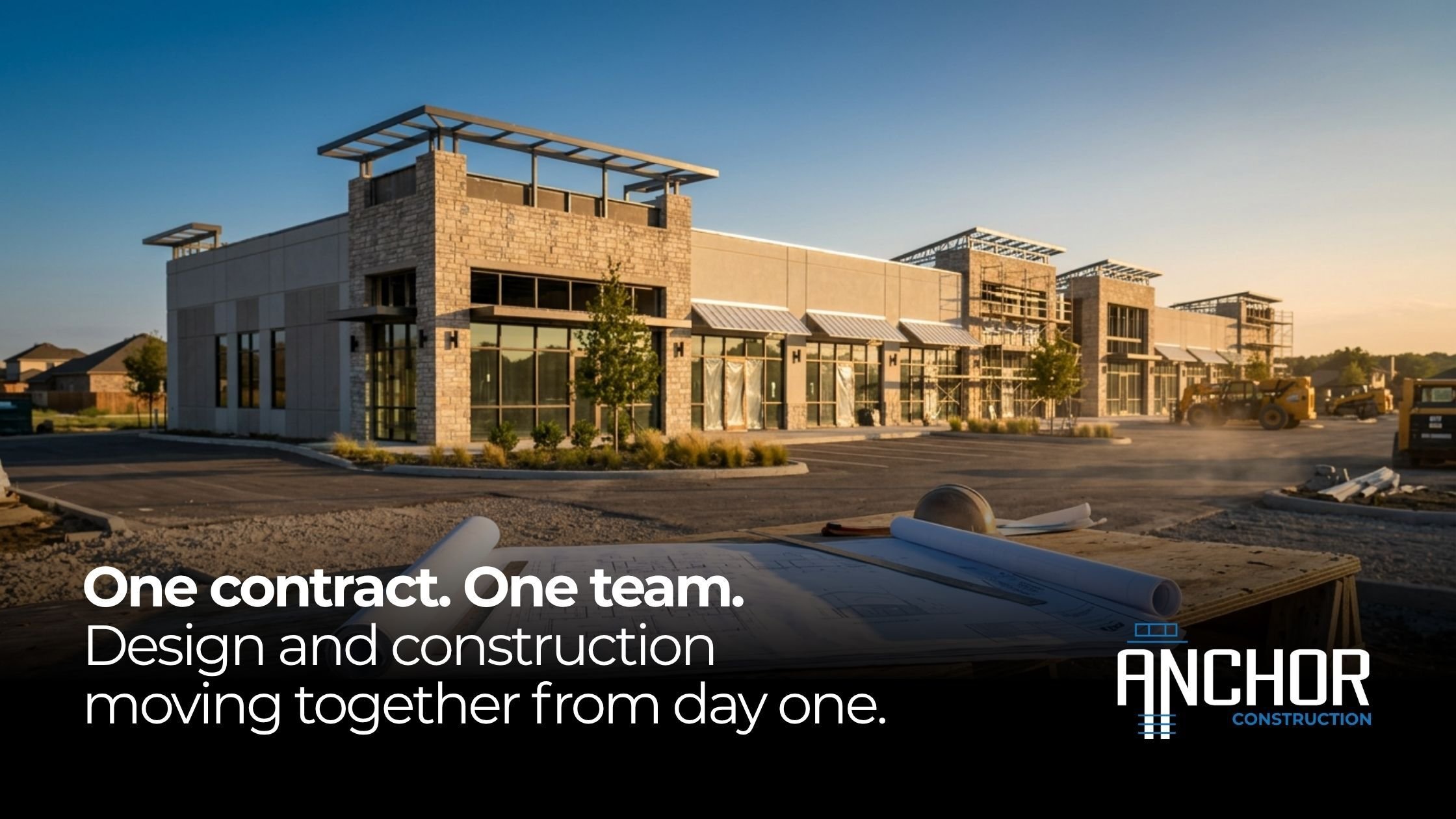
Retail design-build is a project delivery model where one contractor manages both design and construction under a single contract, giving the owner one point of accountability from concept through certificate of occupancy. In Houston, this model delivers retail projects 20 to 30 percent faster than traditional design-bid-build by allowing design and construction to overlap rather than run sequentially. For chains executing prototype rollouts across multiple Texas markets, design-build allows the GC to lock a prototype and replicate it efficiently without re-engaging a separate architect for each location.
TL;DR
-
Design-build: one contract, one team, design and construction overlapping. Traditional: architect first, then bid, then build. Design-build is 20-30% faster.
-
Houston-specific advantage: at 7.5-9.5% construction loan rates, a 90-day schedule compression on a $2M project saves $37,500-$57,000 in carry costs.
-
Best fit for retail chains: prototype rollouts, speed-to-revenue priority, limited internal PM capacity, multi-site programs.
-
Not always the right fit: projects requiring independent design oversight from a lender, public agency, or complex custom program.
-
The real test: a design-build GC should be able to demonstrate constructability review, value engineering, and overlap between design and construction phases.
What Is Retail Design-Build and How Does It Differ From Traditional Delivery?
In traditional design-bid-build, the process runs in sequence. The owner engages an architect to produce complete construction documents. Once the documents are done, the owner solicits bids from contractors. Once a contractor is selected, construction begins. The three phases happen one after another, with gaps between each one.
Design-build collapses that sequence. One firm holds both the design and construction contract, which allows the two phases to overlap. While the architect is finalizing construction documents for one portion of the project, the contractor can be breaking ground on another. The result is a shorter total project timeline and a single point of accountability for both design and construction outcomes.
For retail projects, the practical benefits are specific:
- No gap between design intent and construction execution. When the same team that designed the project builds it, the interpretation errors that generate change orders in traditional delivery largely disappear. The contractor already understands the design intent because they participated in creating it.
- Constructability built into the design. A design-build GC reviews every design decision for constructability before it is finalized. Details that would create coordination conflicts or schedule problems in the field are caught in the design phase, when they cost nothing to change.
- Faster permit submission. In Harris County and the City of Houston, a design-builder with in-house permitting experience can structure scope phasing to accelerate permit issuance — a strategy unavailable to a GC who receives completed drawings from an independent architect.
For more on how construction management and delivery model selection affect retail project outcomes in Texas, see our complete guide on retail construction management in Texas.
When Does Design-Build Make Sense for a Retail Chain in Houston?
Design-build is not the right model for every project. For retail chains, the fit depends on four conditions. The more of these that apply, the stronger the case for design-build.
1. The project is prototype-driven. National QSR brands, pharmacy chains, and medical office networks executing multi-site Houston rollouts benefit most from design-build. Once the prototype is designed, the GC can permit and replicate it across locations without re-engaging a separate architect for each site. Anchor's retail programs for chains across Houston, DFW, Austin, San Antonio, and Corpus Christi follow exactly this logic.
2. Speed to revenue is the primary constraint. Every week between lease signing and opening day is a week of lost sales and ongoing occupancy cost. At Houston construction loan rates of 7.5 to 9.5 percent, a 90-day schedule compression on a $2M project saves $37,500 to $57,000 in carry costs alone, enough to fund a meaningful tenant improvement allowance.
3. The owner has limited internal project management capacity. Design-build gives the owner one point of contact for every decision across design and construction. For a store development team managing a multi-site rollout, eliminating the coordination overhead between a separate architect and contractor reduces the internal management burden significantly.
4. The project does not require independent design oversight. Some projects require a separately contracted architect: lender requirements for certain loan structures, public agency projects, historic renovations, or complex custom programs where the owner wants competitive bids on complete documents. If none of these apply, design-build is generally the faster and more cost-efficient path.
For more on how multi-site retail programs are managed across Texas markets, see our guide on what issues retail developers face managing large construction programs.
What Should Retail Chains Look for in a Design-Build Partner in Houston?
Not every contractor who offers design-build is actually delivering it. The label is easy to apply. The discipline is harder to demonstrate. Here is what to look for when evaluating a design-build partner for retail construction in Houston:
- Proof of design-construction overlap on past projects. Ask for a project timeline showing when design was finalized and when construction began. On a genuine design-build project, construction starts before design is complete. A contractor who simply hired an in-house drafter but still follows a sequential process is not delivering design-build.
- Constructability review documentation. A design-build GC should be able to show specific examples of design decisions they revised for constructability before the project went to permit. If they cannot point to concrete examples, the constructability review is theoretical.
- Permitting experience in your specific Houston market. Harris County and the City of Houston have different permitting processes. Suburban markets like Katy, Pearland, and Sugar Land permit through their own jurisdictions. A design-build contractor who knows how to phase scope submissions to accelerate permit issuance in each specific jurisdiction delivers a schedule advantage that a contractor learning the jurisdiction on your project cannot.
- Prototype replication capability for multi-site programs. For chains, the real value of design-build is not just on the first location. It is in the ability to lock a proven prototype and execute it consistently across multiple Houston-area sites. Ask how the contractor manages design consistency and brand compliance when the same prototype is built in multiple locations.
For the full framework on evaluating a GC before signing, including the question most clients never ask, see our guide on what to ask your GC before signing a commercial construction contract.
How Does Anchor Construction Approach Retail Design-Build in Houston?
Anchor Construction operates as a construction management-led GC, which means many of the same benefits that retail chains seek in design-build are built into how we approach every project, regardless of the formal contract structure.
Our pre-construction process engages the design team before construction documents are finalized. We review the design for constructability, identify brand specification gaps before they become change orders, and manage the permitting process in each specific Texas jurisdiction from day one. On multi-site programs, we lock the prototype after the first location and replicate it across subsequent sites with the brand compliance and schedule consistency that chains require.
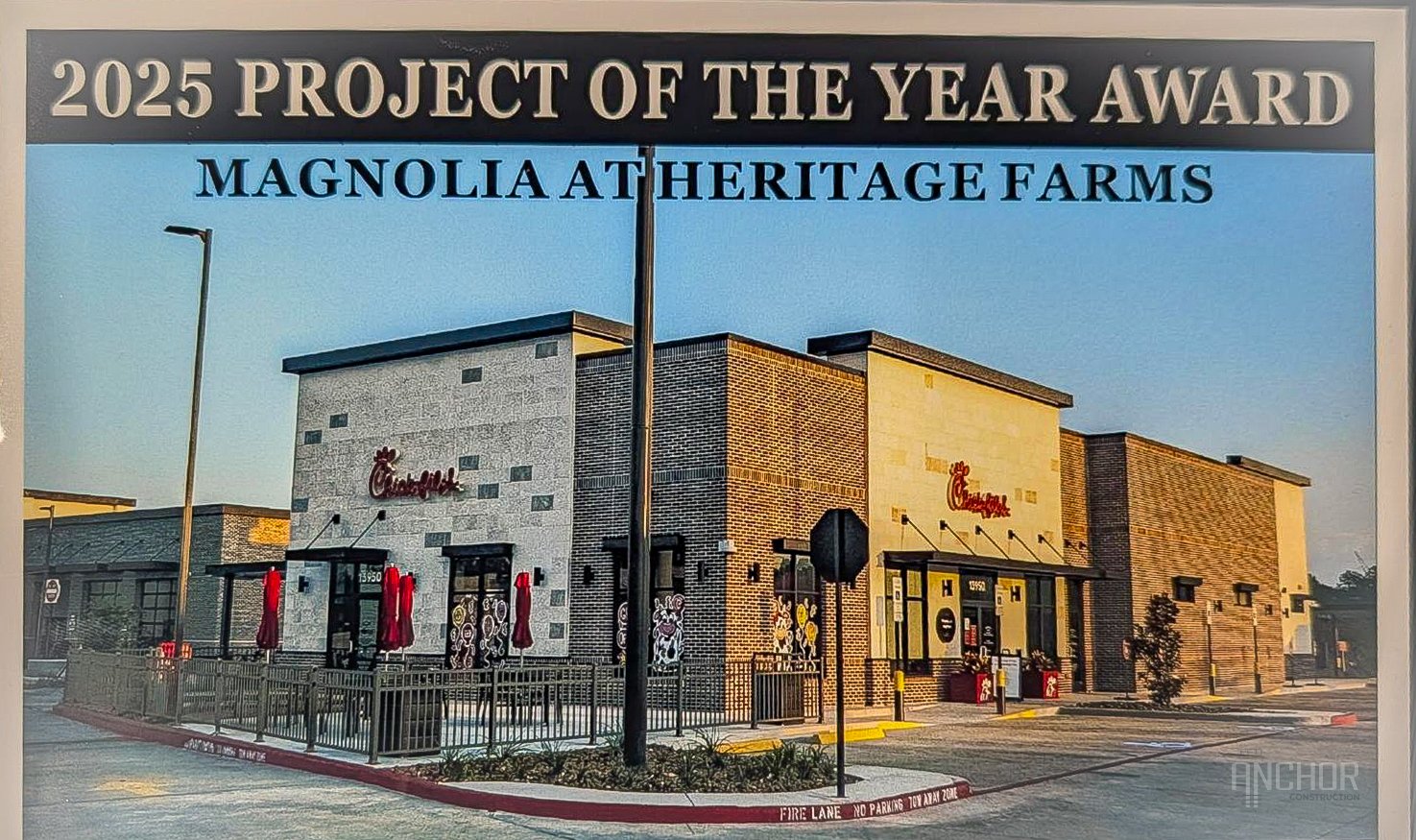
The retail and restaurant programs we have executed across Houston, including Chick-fil-A, Whataburger, Bojangles, Cyclone Anaya's, and Burger Bodega, reflect a construction management approach where the benefits of design-build, speed, cost control, and single accountability, are delivered through early GC engagement rather than a formal design-build contract structure.
For some clients and some projects, a formal design-build contract is the right structure. For others, construction management with early engagement delivers equivalent outcomes within a contract structure the owner's lender or legal team is more comfortable with. Either way, the work that produces those outcomes happens in the same phase: before mobilization, when problems cost nothing to fix.
To see the range of retail and restaurant projects Anchor has delivered across Houston and Texas, explore our commercial retail portfolio.
Retail design-build in Houston delivers a real advantage for chains that fit the model: 20 to 30 percent faster schedule, reduced construction loan carry, and a single point of accountability across design and construction. For prototype-driven rollouts across the Houston metro and beyond, those advantages compound across every location in the program.
The key is not the label. It is the discipline behind it: early engagement, constructability review built into the design phase, permitting knowledge in each specific jurisdiction, and a GC who is accountable for both the drawings and the building they produce.
In Houston in 2026, where the retail construction pipeline is running at record levels and the best subcontractors are committed months in advance, the chains that execute cleanest are the ones who resolved the design questions before mobilization, not the ones who discovered them during construction.
Planning a retail project in Houston? Let's talk about the right delivery model for your program.
View our retail projects | Talk to our team
FAQ
What is retail design-build and how does it work in Houston?
Retail design-build is a project delivery model where one contractor manages both design and construction under one contract. Unlike traditional design-bid-build where the owner hires an architect separately before bidding to contractors, design-build gives one firm accountability for the entire scope. In Houston, this model is particularly effective for retail chains executing prototype rollouts because the GC can lock a prototype and permit it across multiple sites without re-engaging a separate architect for each location.
What are the advantages of design-build for retail chains in Houston?
Design-build projects in Houston deliver 20 to 30 percent faster schedules than traditional delivery. At current construction loan rates of 7.5 to 9.5 percent, a 90-day compression on a $2M retail project saves $37,500 to $57,000 in carry costs. Single accountability eliminates the disputes between architect and contractor that generate change orders in traditional delivery. For multi-site programs across Houston, DFW, Austin, San Antonio, and Corpus Christi, these advantages compound across every location.
When does design-build make sense for retail construction in Texas?
Design-build makes the most sense when the project is prototype-driven, speed to revenue is the primary constraint, the owner has limited internal project management capacity, and the project does not require independent design oversight from a lender or public agency. For national chains executing multi-site rollouts across Texas, design-build allows the GC to lock a prototype and replicate it efficiently without re-engaging a separate architect for each site.
What is the difference between design-build and design-bid-build for retail?
In traditional design-bid-build, design and construction happen sequentially: architect produces complete documents, owner bids to contractors, then construction begins. In design-build, both phases happen under one contract with overlap, reducing total project duration by 20 to 30 percent. For retail projects, this overlap also eliminates the interpretation gap between design intent and construction execution that generates most change orders.
Does Anchor Construction offer design-build services for retail in Houston?
Anchor Construction provides retail construction management across Houston, DFW, Austin, San Antonio, and Corpus Christi with early GC engagement that delivers design-build benefits: constructability review before design is finalized, value engineering, single accountability from preconstruction through closeout, and prototype replication for multi-site programs. Anchor has built retail and restaurant programs for Chick-fil-A, Whataburger, Bojangles, and Cyclone Anaya's across Texas.
By Pablo Ayala, Head of Marketing, Anchor Construction. Texas retail buildout contractor and 2026 HBJ Fast 100 company, active across Houston, DFW, Austin, San Antonio, and Corpus Christi.
.png)