 By
By
Texas continues to experience rapid commercial growth. From Houston and Dallas-Fort Worth to emerging suburban markets across the state, developers are moving quickly to meet demand for retail, industrial, hospitality, and mixed-use projects.
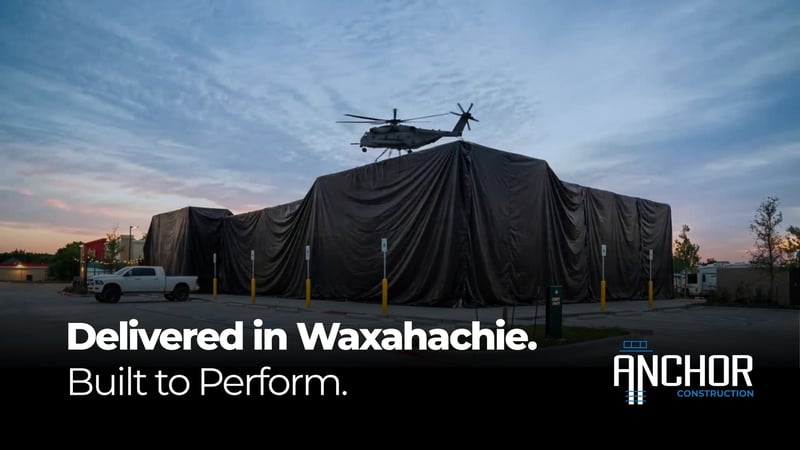
But in today’s environment, choosing the right partner is no longer just about finding a builder. It is about finding a team capable of delivering strong construction project execution from day one through final turnover. Recently, Anchor delivered an 8,439-square-foot multi-tenant retail building along US Highway 77 in Waxahachie, Texas, designed to support future tenants efficiently.
Projects like this reflect an important reality in today’s market: choosing the right partner is no longer just about finding a builder. It is about finding a team capable of delivering strong construction project execution from day one through final turnover.
The Role of a Commercial General Contractor Has Changed
Years ago, many developers evaluated contractors primarily on pricing and scheduling. Today, the stakes are significantly higher.
A strong commercial general contractor must now balance:
- Efficiency
- Budget management
- Site coordination
- Risk mitigation
- Tenant readiness
- Long-term asset performance
And in Texas, where construction activity remains highly competitive, execution matters even more.
The right general contractor in Texas doesn’t simply manage trades. They help developers protect investments, maintain timelines, and create assets that lease, operate, and perform successfully after construction is complete.
What Developers Should Prioritize When Selecting a General Contractor in Texas
1. Proven Construction Project Execution
Plans are important. Execution is everything.
Developers should look for contractors with a proven ability to coordinate sitework, utilities, scheduling, inspections, and trade management efficiently while maintaining quality throughout the project lifecycle.
A contractor’s ability to solve problems proactively often determines whether a project stays on track or becomes delayed by avoidable issues.
Strong construction project execution also means understanding the end goal:
- Tenant readiness
- Operational functionality
- Long-term durability
- Presentation and curb appeal
Because ultimately, developers are not investing in construction activity. They are investing in a finished asset.
2. Understanding of Texas Commercial Growth Markets
Every market in Texas moves differently.
A contractor familiar with regional development trends, permitting environments, utility coordination, and infrastructure requirements can help projects move more efficiently and avoid unnecessary delays.
This is especially important in rapidly growing corridors surrounding Dallas-Fort Worth, Houston, Austin, and San Antonio, where retail and commercial demand continue expanding outward from major metro areas.
Developers benefit from working with teams that understand how to navigate these growth environments strategically.
3. Ability to Deliver Tenant-Ready Assets
Commercial developments succeed when spaces are ready to perform.
For retail developers, that means creating assets that:
- Attract tenants
- Support efficient build-outs
- Present well from high-traffic corridors
- Function operationally from day one
This requires more than vertical construction. It requires coordinated execution across:
- Sitework
- Drainage and detention
- Exterior finishes
- Access and circulation
- Utility infrastructure
The most effective commercial general contractors understand that leasing success often begins during construction.
A Recent Example of Execution in Texas
Recently, Anchor Construction completed and delivered a multi-tenant retail building along US Highway 77 in Waxahachie, Texas.
The project included:
- 8,439 square feet
- Four leasable retail suites
- A drive-thru coffee end-cap
- Three retail storefronts
- 1.512 acres positioned along a primary corridor into the Dallas-Fort Worth Metroplex
The building was delivered as a shell designed to efficiently accommodate future tenants while maintaining strong visibility and presentation from the highway.
The scope also included:
- Full sitework
- Stormwater detention
- Exterior package completion
- Coordinated delivery aligned with the development plan
For developers, this is what matters most:
A finished asset built to perform, ready to lease, and designed with purpose.
Why the Right General Contractor Matters
In today’s Texas market, developers need more than builders. They need strategic construction partners capable of delivering projects with consistency, accountability, and precision.
The right commercial general contractor helps reduce risk, improve execution, and position developments for long-term success. Because successful projects are not measured only by when construction starts.
They are measured by how well the asset performs once it is complete.
FAQs
What should developers look for in a general contractor in Texas?
Developers should look for experience, strong construction project execution, communication, market knowledge, and the ability to deliver projects efficiently while protecting long-term asset performance.
What does a commercial general contractor do?
A commercial general contractor manages construction operations, trade coordination, scheduling, budgeting, site execution, and overall project delivery for commercial developments.
Why is construction project execution important?
Strong execution helps projects stay on schedule, reduce costly delays, improve quality, and ensure the finished asset is ready for leasing and operations.
Why are Texas commercial markets growing so quickly?
Texas continues to experience strong population growth, business expansion, and infrastructure investment, driving increased demand for retail, industrial, hospitality, and mixed-use developments.
What makes a successful retail development project?
Successful retail developments combine strong location strategy, quality construction, efficient site coordination, tenant-ready design, and long-term operational functionality.
Let’s Build What’s Next
If you're planning a commercial, retail, or multifamily project, the right general contractor will define your outcome.