 By
By
The question developers ask most when entering a new Texas market is not who is the largest GC in the region. It is who can actually execute a 150-unit project on a compressed timeline without the civil surprises, phasing delays, and subcontractor gaps that push delivery dates and erode returns.
The answer is not a ranked list. It is a set of capabilities. The multifamily general contractors in Texas who deliver consistently share the same traits, regardless of company size. Here is what those traits are and how to evaluate them before you sign.
The top multifamily general contractors in Texas share five capabilities: civil coordination experience across the state's varied site conditions; multi-phase scheduling that delivers units to a leasing timeline without halting the full project; established subcontractor networks in each target market; pre-construction services that identify design and civil conflicts before mobilization; and a track record of completing 100-plus-unit projects with the same ownership team from preconstruction through closeout. A GC who checks all five is the one worth the conversation.
-
Civil coordination: deep submarket knowledge and site-specific experience in the Greater Houston area
-
Multi-phase scheduling: unit delivery to a leasing timeline while construction continues on remaining phases
-
Sub networks: pre-qualified trades per market, not assembled at bid day
-
Pre-construction: civil, structural, and MEP conflict resolution before mobilization
-
Ownership continuity: same team from preconstruction through closeout, not handed off at permit
1. Deep Market Knowledge in the Submarket Where You Are Building
Texas is not one market, and Houston is not one submarket. Site conditions, permitting timelines, and civil requirements in Pasadena differ from those along the Energy Corridor, and both differ from what a project in Sugar Land or the Resource Parkway corridor demands. A multifamily GC who applies a single playbook across locations will discover those differences at mobilization, not at pre-construction, where they are cheapest to solve.
What to ask: how many projects has the GC completed in your specific submarket, and what were the civil conditions at each site? A GC with genuine local depth will give specific answers, soil conditions, city review cycles, utility coordination timelines. One who cannot speak to those specifics at the pre-construction stage has not done it at the level your project requires.
What this looks like in practice
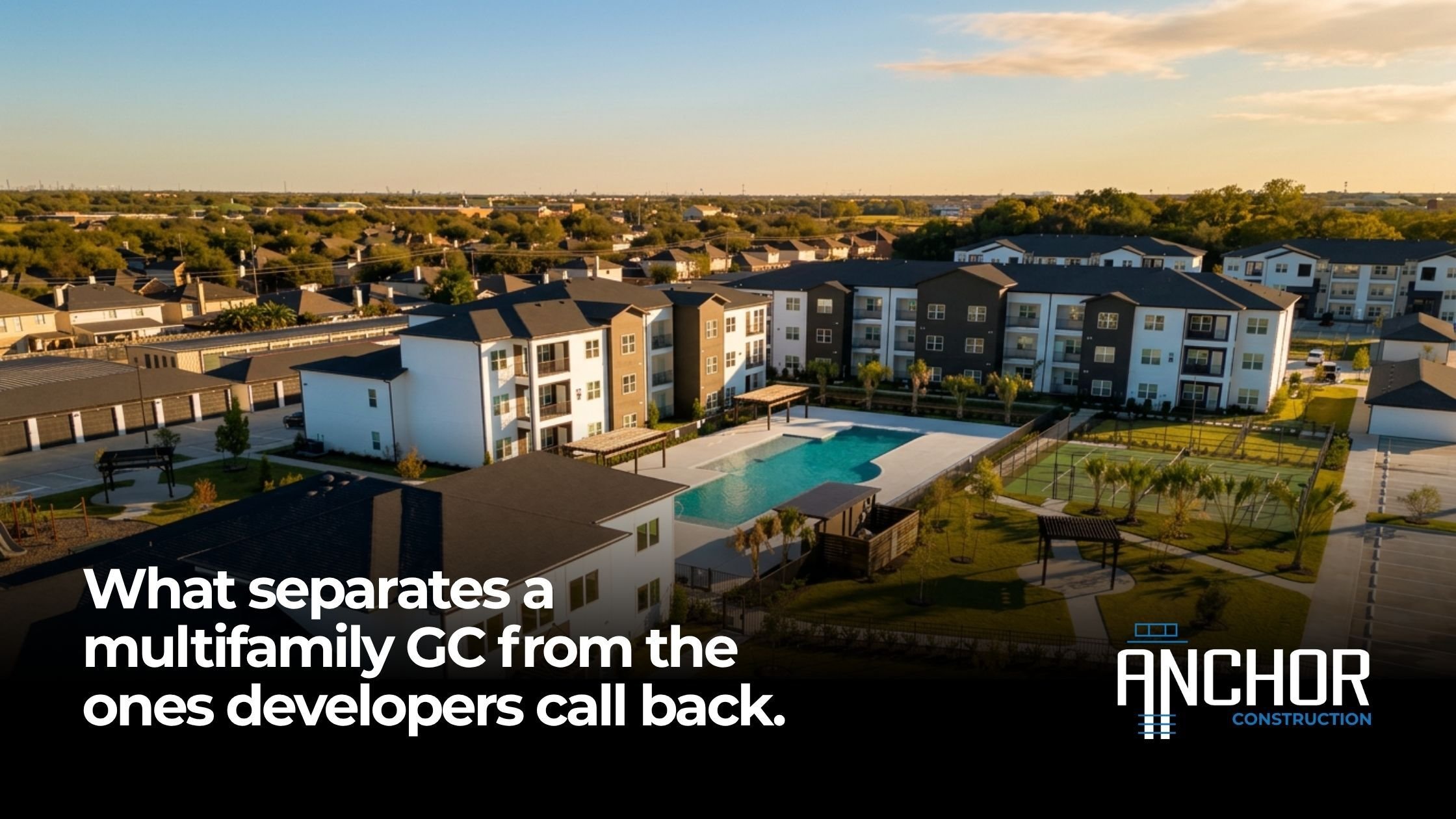
Anchor Construction's multifamily work is concentrated in the Greater Houston area, where our team has built an operational knowledge base that goes beyond project count. The Aria at Burke project in Pasadena (152 units) and Aria at Resource along the Resource Parkway corridor in Houston (160 units) both required site-specific civil coordination from the first day of pre-construction engagement, not because they were unusual projects, but because every site in this market has conditions that have to be read individually.
Our crew carries field experience across Texas markets, which means the team on your project has seen how those conditions vary and can flag when a Houston assumption does not apply.
For more on what this coordination requires at the project level, see our guide on what makes multifamily construction more complex than it looks.
2. Multi-Phase Scheduling That Protects the Leasing Timeline
Multifamily developers lease units while construction continues on other phases of the same project. That means the GC must deliver finished, CO-ready units on a schedule the leasing team can put in front of prospective residents, while simultaneously managing active construction on buildings that share the same site, utilities, and subcontractor pool.
The failure mode is common: construction on later phases creates noise, dust, and access disruptions that damage early-phase resident experience and leasing velocity. A GC who has not built multifamily projects at this scale will sequence the project the way a commercial GC would, without accounting for the resident experience implications of that sequence.
What to ask: how has the GC managed unit delivery sequencing on prior projects above 100 units? Ask for a specific example with phase count, unit delivery dates, and how the leasing team was involved in the schedule development.
"On a 150-plus unit multifamily project, subcontractor coordination only works if the leasing timeline is at the center of every conversation. When one phase starts putting pressure on another, the first step is identifying the critical path activities and the specific handoffs being affected, then communicating the impact early, before it becomes an issue.
If a trade falls behind, we build a recovery plan together: adjusted manpower, realistic completion dates, and clear accountability to those commitments. The goal is always to protect the leasing schedule without sacrificing quality or safety.
What Aria taught me that I would not have anticipated going in is how interconnected every decision is on a multifamily project. A delay that looks small in one trade can ripple into inspections, turnover, leasing, and ultimately the owner's schedule. Aria pushed me to look beyond my individual scope, anticipate problems earlier, communicate proactively, and understand how my decisions affect the entire project and the team."
— Benjamin Avendano, Superintendent, Multifamily and Hospitality Division, Anchor Construction
3. Established Subcontractor Networks in the Target Market
Framing, MEP, and finish quality on a multifamily project are determined largely by subcontractor quality. In active Texas markets, the best subs are committed months in advance. A GC who pre-qualifies sub networks in Houston, DFW, Austin, San Antonio, and Corpus Christi before a project starts has access to those subs at bid day. A GC who is new to a market or assembles subs at bid day takes whoever is available.
Sub consistency across a multi-phase project also matters. Unit finish quality drifts when different sub crews work to slightly different interpretations of the same specification. A GC who uses the same pre-qualified finish subs across all phases of a project maintains the consistency that drives resident satisfaction scores and reduces punch list time before CO.
What to ask: who are the GC's primary framing, MEP rough, and finish subcontractors in the specific submarket where you are building? A GC with real market presence will name firms and be able to describe their working history with each one.
4. Pre-Construction Services That Find Problems Before Mobilization
The most expensive problems in multifamily construction are the ones discovered after mobilization. A structural coordination gap between the architect's drawings and the MEP engineer's routing that goes unchecked in pre-construction becomes a request for information during framing, which creates a schedule delay and a change order. Multiplied across 150 units, the same gap produces the same cost and schedule impact on every unit where it appears.
A top multifamily GC runs a pre-construction process that produces specific outputs: civil and geotechnical analysis per site, permitting pre-check in the relevant jurisdiction, structural and MEP coordination review against the architect's drawings, and a budget built on actual subcontractor input from the target market, not national cost data or assumptions from another city.
For a detailed breakdown of what strong pre-construction services include for Texas projects, see our post on what preconstruction services actually cover for large projects.
5. Ownership Continuity From Preconstruction Through Closeout
One of the most consistent failure points in multifamily construction is the handoff. A GC who assigns a senior team to pursue and win a project, then transitions that project to a different field team at permit, leaves the developer with people who did not make the commitments embedded in the contract and schedule. The institutional knowledge built during pre-construction does not transfer cleanly, and the field team spends the first month of construction catching up.
What to ask: who will be the superintendent on this project from mobilization through CO? Is that person currently available, or are they committed to another project through the phase when yours would start? A GC who cannot name the superintendent at proposal stage is likely planning to assign one at the last minute.
What Anchor Construction's project teams look like
Anchor's multifamily projects are staffed with a superintendent and project manager assigned at pre-construction, not at permit. On both the Aria at Burke project (152 units, Pasadena) and Aria at Resource (160 units, Houston), the field leadership present at the first pre-construction meeting is the same team that carries the project through CO. That continuity is not an accident of scheduling. It is a hiring and project assignment model built around it.
6. A Track Record That Matches the Project Type You Are Building
Multifamily experience is not interchangeable. A GC who has built garden-style surface-parked communities does not have the same experience as one who has built 4-story wood-frame over podium. A GC who has built 50-unit projects does not have the same subcontractor relationships, schedule management systems, or staff depth as one who has completed 150-unit projects. The right question is not whether the GC has built multifamily. It is whether they have built the specific type of multifamily project you are developing, at the unit count you are targeting, in the Texas market where you are building.
Ask for the project list filtered by project type, unit count, and delivery market. A GC with genuine experience at your project scale will have specific examples to share and will be comfortable connecting you with the developer of record on those projects.
For context on how Anchor approaches multi-site and complex commercial programs, see our overview of retail construction management services in Texas.
Anchor Construction is a Texas multifamily and commercial general contractor active across Houston, DFW, Austin, San Antonio, and Corpus Christi. Current multifamily projects include Aria at Burke (152 units, Pasadena) and Aria at Resource (160 units, Houston). The 2026 HBJ Fast 100 recognition reflects growth across multifamily, retail, restaurant, and hospitality sectors, built on a project team model where the same leadership that wins the project delivers it through CO.
Developing a multifamily project in Texas? Talk to Anchor about what pre-construction and execution look like at your unit count.