 By
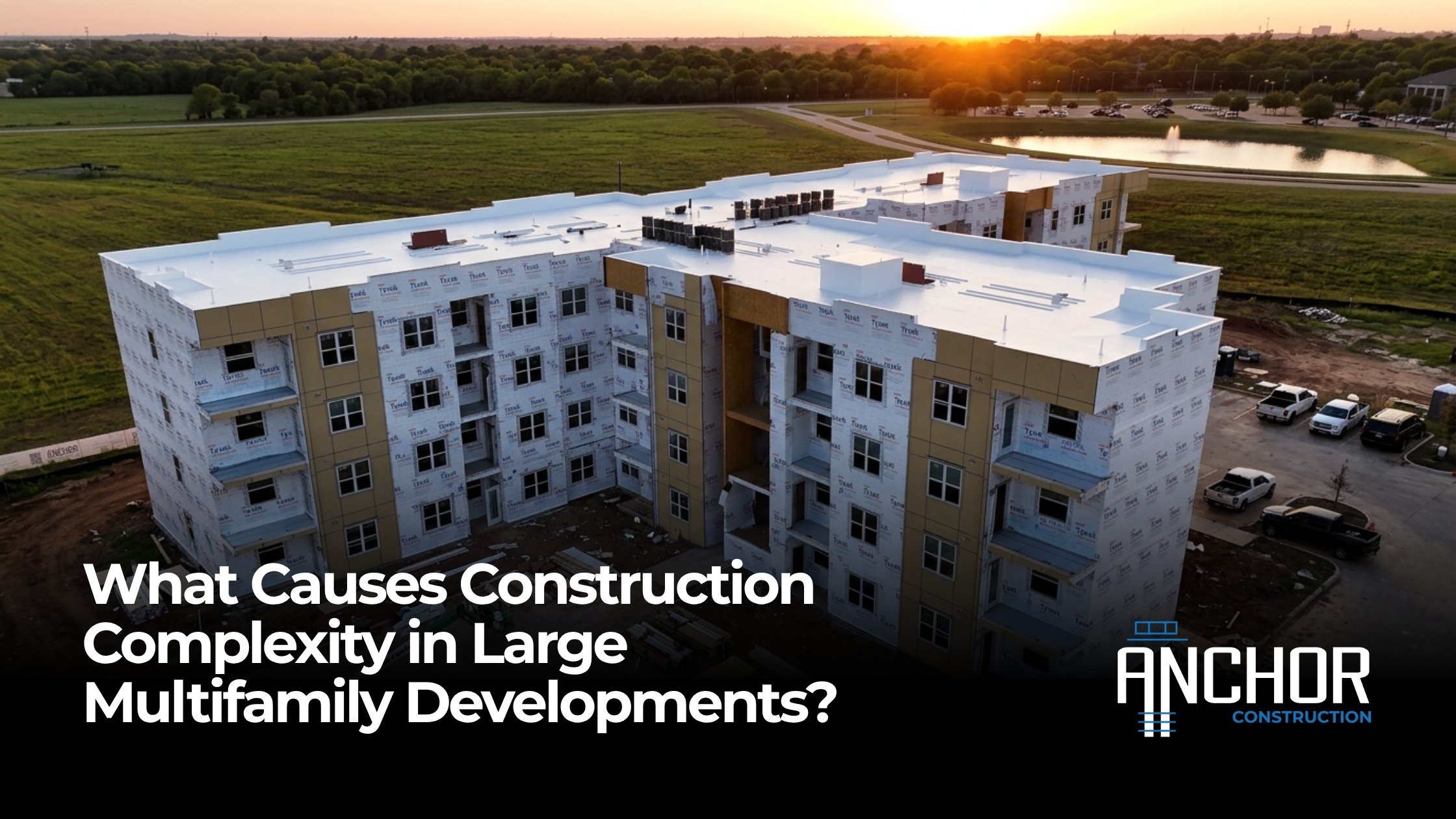 Large multifamily construction becomes complex when multiple floors are active simultaneously, each with its own MEPF rough-in, framing, and concrete sequence running in parallel. The challenge is not any single trade. It is the coordination layer between all of them, floor by floor, on a schedule where one delay cascades upward through every level above it. A project at this scale requires a GC with the systems to track vertical sequencing in real time, not just at weekly site meetings.
TL; DR
-
Multi-floor simultaneous activity is the root of most large multifamily delays
-
MEPF rough-in across 100-plus units requires precise floor-by-floor sequencing
-
Vertical sequencing compresses timelines but demands real-time trade coordination
-
A concrete pour on one level can only happen after trades clear and frame the floor below
-
The right GC prevents cascading delays before they start, not after they are already behind
-
What is your most recently completed multifamily project at this scale? How many stories, how many units?
-
How do you manage simultaneous floor activity? Walk me through your trade sequencing process.
-
How do you handle a concrete pour window when a floor below is behind schedule?
-
What is your preconstruction process for MEPF coordination across multiple floors?
-
Who is your day-to-day project manager on site, and how do they communicate with the owner?
What Makes Large Multifamily Projects More Complex Than Other Commercial Construction?
A 6-story hospitality or multifamily building in Houston or Austin is not simply a larger version of a retail build-out. The scale changes the entire coordination model. In a single-story commercial project, trades move floor to floor in sequence. In a large multifamily development, framing crews, MEPF teams, sheathing installers, and concrete teams are working on different floors at the same time, often with different completion deadlines for each level.
That creates a coordination challenge that does not exist in simpler commercial builds. When Level 1 has MEPF rough-in underway and Level 2 is receiving sheathing while Level 5 is being framed, each trade has its own schedule and its own floor-clearance deadline. Miss one, and the delay does not stay on that floor. It travels up.
This is exactly the environment Anchor manages on active large-scale projects in Texas, from Houston to San Antonio to the Dallas-Fort Worth metro. The complexity is predictable. What separates GCs is whether they have built the systems to manage it before it becomes a problem.
What Are the Real Challenges in Large-Scale Multifamily Construction Management?
The challenges in large multifamily construction fall into four categories. Understanding them helps developers ask better questions when selecting a GC.
|
Challenge Category |
Why It Matters at Scale |
|
Vertical Sequencing |
Lower floors close in while upper floors are still being framed. Each level must be cleared on schedule or the delay cascades up. |
|
MEPF Coordination |
Mechanical, electrical, plumbing, and fire rough-in runs across dozens of units per floor. One trade out of sequence blocks framing and sheathing on the entire level. |
|
Concrete Pour Scheduling |
Deck pours require the floor below to be framed, sheathed, and cleared. A pump truck on site means that schedule is locked. Missing the window costs days. |
|
Trade Sequencing Pressure |
Each trade clears a floor to pass it to the next. At 6 stories with parallel activity, that handoff happens simultaneously across levels. A GC without real-time tracking cannot manage this from a weekly meeting. |
What Pre-Construction Steps Prevent Large-Scale Multifamily Delays?
Most coordination failures in large multifamily projects are preventable. They do not start during construction. They start in preconstruction, when the schedule is set and trade sequences are defined. Here is how Anchor approaches this phase:
1. Floor-by-floor trade sequencing: Before the first shovel breaks ground, the sequence in which each trade enters and clears each floor is mapped out. Not just globally but per level.
2. MEPF coordination meetings: MEP contractors, structural, and framing teams align on their floor-clearance timelines before mobilization. Conflicts are resolved on paper, not in the field.
3. Concrete pour scheduling: Deck pour windows are locked early. Pump truck availability is confirmed against the floor-framing schedule. The window does not move because a trade ran late.
4. Look-ahead scheduling: A rolling 3-week look-ahead is updated continuously as work progresses on multiple floors. When Level 1 is behind, the schedule impact to Level 3 is visible before Level 2 is even started.
This preconstruction investment is what allows simultaneous vertical activity to function. Without it, a 6-story multifamily project becomes a 6-story series of delays, each one waiting for the floor below to catch up.
Anchor's approach to construction management services for national retail chains follows the same coordination model applied to multifamily: trade sequencing, schedule precision, and preconstruction alignment before mobilization.
How Do You Evaluate a General Contractor for a Large Multifamily Project in Texas?
Selecting a GC for a large-scale multifamily project in Texas, whether in Houston, DFW, Austin, San Antonio, or Corpus Christi, should begin with a set of specific questions about how they manage vertical complexity, not just their bid price.
Ask these five questions in your evaluation:
A GC that struggles to answer these questions specifically is not managing complexity from a system. They are reacting to it.
Anchor is currently managing Aria at Resource, a large-scale multifamily development where framing is 100% complete, the roof system on Building A is finished, and drywall installation is underway. Projects at this scale require the exact coordination systems described above, trade sequencing, inspection milestones, and parallel activity across buildings managed as one schedule.
Before signing a contract, review commercial construction cost per square foot across Texas markets to benchmark your project against current Houston, DFW, and Austin pricing. Cost and complexity are related.
For hospitality developers specifically, how Anchor delivers hospitality construction in Houston covers the coordination model applied to hotel projects, where per-key scheduling mirrors the per-unit sequencing of large multifamily builds.
Working on a Large Multifamily or Hospitality Development in Texas?
Anchor Construction Management is a commercial GC operating across Houston, DFW, Austin, San Antonio, and Corpus Christi. We build multifamily and hospitality projects with the coordination systems that large-scale vertical construction requires.
If you are in preconstruction or evaluating GCs for a multi-story project, we would like to hear about it.
Talk to Anchor about your project, we build for complexity, not despite it.
See how Anchor manages construction management services for national retail chains in Texas the same trade-coordination and preconstruction model scales to multifamily and hospitality.
Frequently Asked Questions
What causes complexity in large multifamily construction projects?
Complexity in large multifamily projects comes from simultaneous multi-floor activity. When MEPF rough-in, framing, sheathing, and concrete pours are running on different levels at the same time, each trade must clear its floor on schedule. One delay cascade upward through every level above it. The complexity is not any single task. It is the coordination between all of them, happening in parallel.
How does a GC manage multiple floors moving at the same time?
A GC manages concurrent floor activity through phased look-ahead scheduling, floor-by-floor trade sequencing, and daily coordination between MEP, framing, sheathing, and concrete crews. Each floor has a clearance deadline that must be met before the next trade enters. The GC's role is to enforce that sequence across all active levels simultaneously, not just track it on a spreadsheet.
What is vertical sequencing in multifamily construction?
Vertical sequencing means lower floors are closing in while upper floors are still being framed and decked. It compresses the overall schedule significantly, but it requires precise daily coordination between MEPF, framing, sheathing, and concrete crews on every active level. A GC managing a 6-story multifamily building may have three or four floors in different construction phases simultaneously. That is vertical sequencing in practice.
Why does MEPF coordination matter more in large multifamily than in other project types?
In a large multifamily or hospitality building, MEPF rough-in runs through dozens or hundreds of individual units across multiple active floors. One trade out of sequence can block framing, sheathing, and concrete pours on an entire level. At scale, MEPF is not a subcontractor task. It is a critical path item that every other trade depends on.
How do I evaluate a GC for a large-scale multifamily project in Texas?
Evaluate a GC by asking about comparable completed projects at the same story count and unit volume. Ask specifically how they manage vertical sequencing, how they handle MEPF conflicts before mobilization, and who owns day-to-day schedule enforcement on site. A GC that answers with process, not just experience, has likely built the coordination systems the project requires.
Sources:
Anchor Construction. Aria at Resource active project data, October 2026
Benjamin Avendano, Superintendent. Aria at Resource, Anchor Construction
Ethan Kahlden, Project Manager. Aria at Resource, Anchor Construction