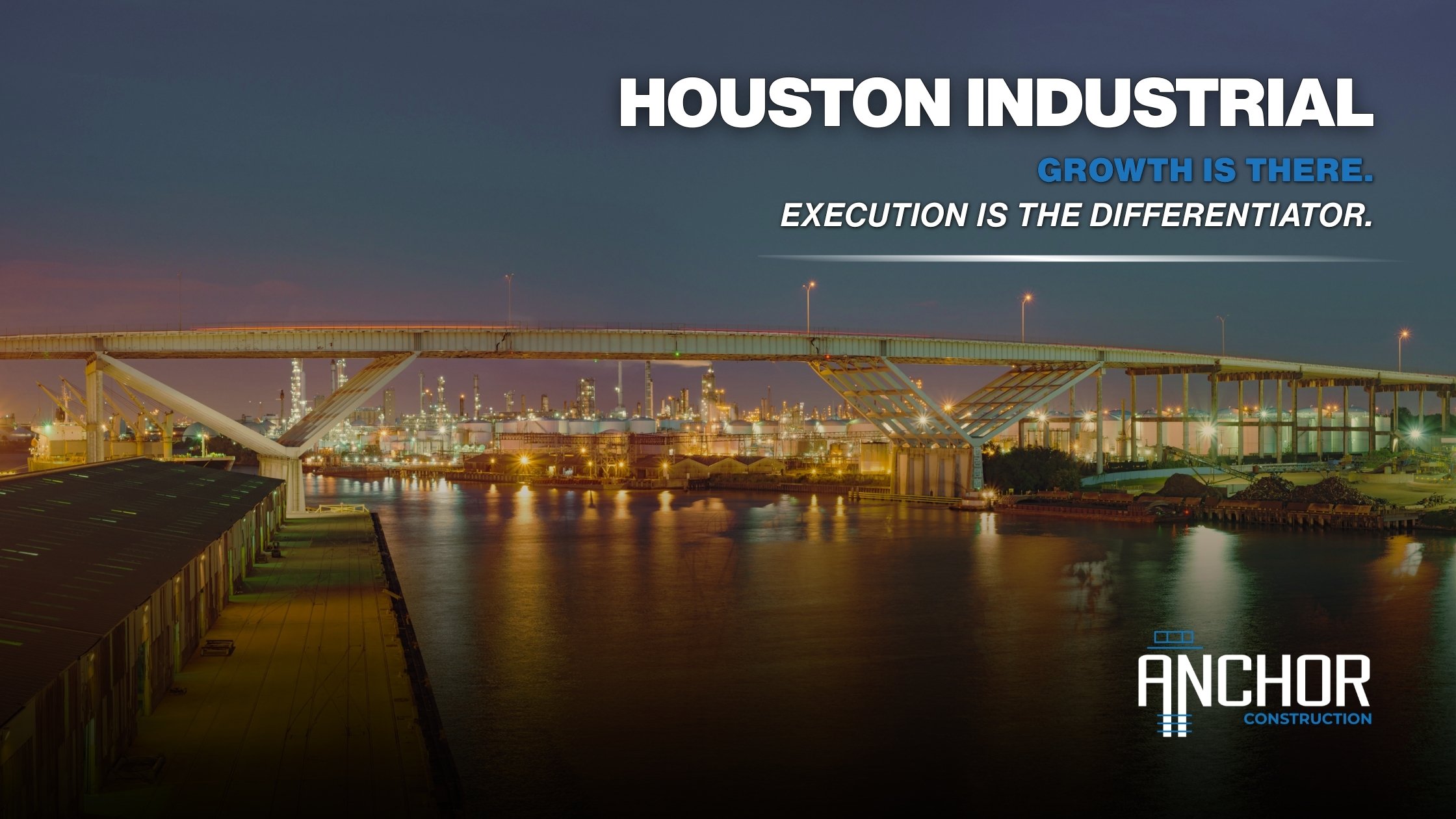
Houston’s industrial market isn’t slowing down. It’s evolving.
At the Houston Industrial Summit, conversations around feasibility, infrastructure, and tenant demand all pointed to the same conclusion:
Demand remains strong. But delivering projects is getting more complex.
Houston Has Become a Top-Tier Industrial Market
Houston is no longer a secondary market. It is competing with Dallas, Chicago, and Atlanta on scale and activity.
Recent market data shows:
- 13.6M SF of net absorption in 2025
- Over 21M SF currently under construction
- Vacancy holding below 7% despite major deliveries
At the same time, the region continues to benefit from strong port activity. Port Houston handled over 4.3 million TEUs in 2025, reinforcing Houston’s position as a critical logistics hub.
This is sustained, infrastructure-backed growth. Not a short-term cycle.
The Product Mix Is Shifting
One of the biggest takeaways from the summit was the shift in how industrial product is being delivered.
Developers are balancing:
- Mid-size spec buildings (100K–200K SF range)
- Build-to-suit demand from major users
- Slower lease-up on large-format facilities
Market reports confirm this tension.
While construction remains strong, large industrial buildings are taking longer to lease, and new supply has begun to outpace demand in certain segments.
The market isn’t slowing. It’s recalibrating.
Infrastructure Is the Real Constraint
Across every panel, one challenge kept coming up: Infrastructure determines what actually gets built.
That includes:
- Power availability
- Water and drainage capacity
- Road access and logistics flow
- Entitlement timelines
Houston’s growth is supported by major infrastructure investments like Ship Channel expansion and highway systems, but those same systems are now under pressure.
As development spreads outward, site readiness becomes the biggest risk factor, not demand.
Design and Performance Are Now Linked
Industrial buildings today are expected to perform from day one.
Tenants are demanding:
- Higher power loads
- Efficient loading and circulation
- Flexible layouts
- Integrated office and support space
Market data reinforces this shift. High-quality, well-located assets continue to outperform, while less efficient product faces longer lease cycles.
Design is no longer aesthetic. It’s operational.
Anchor’s Perspective: Buildability Wins
At Anchor Construction, that is where we focus.
What was discussed at the summit reflects what we see in the field every day: projects do not fall behind because of construction alone. They fall behind because of incomplete site evaluation, late coordination, and infrastructure gaps identified too late.
A strong public example is the Marina Bay Harbor dry storage expansion in Clear Lake Shores. Marina Bay Harbor says the project includes a 63,990-square-foot expansion barn with 288 slips, a 5,000-square-foot ship store, and names Anchor Construction as one of the supporting partners helping deliver the project.
That kind of project reinforces the point:
- Site constraints define the schedule
- Infrastructure defines feasibility
- Early coordination defines success
Buildability is no longer a phase. It is the strategy.
Closing: The Bar Has Been Raised
Houston’s industrial market is strong.
- Demand is driven by logistics, manufacturing, and population growth
- Infrastructure investment continues
- Capital is still active
But the difference today is execution.
Anyone can plan a project. Not everyone can deliver one.